SFCM Bids a Fond Farewell to Beloved Opera Teacher César Ulloa
Ulloa joined the San Francisco Conservatory of Music 20 years ago.

César Ulloa with a student in 2019.
Among opera pedagogues, César Ulloa's voice stands out.
With 15 years onstage with some of the icons of the opera world, and two decades teaching at SFCM, Ulloa's impact in the Bay Area—and beyond—can't be measured in those terms alone. As he bids farewell to SFCM, the Conservatory is spotlighting one of its most-loved figures.
After a long and esteemed teaching career, César Ulloa leaves behind a legacy of service and devotion to SFCM that will be with us for years to come. We wish him a happy and healthy next stage of his teaching journey." —Voice Department Executive Chair Richard Cox
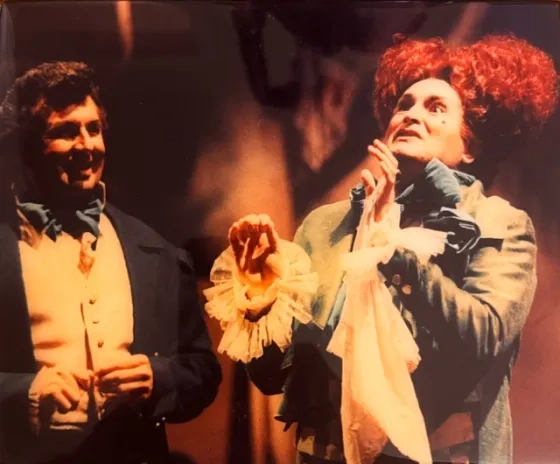
Ulloa (right) as Spalanzani in Jacques Offenbach's "The Tales of Hoffman."
Ulloa's family fled the Castro regime in Cuba in 1960, landing in Spain before eventually settling in Texas. As a young man, however, he was still searching for the path he wanted to follow. "I had a real gift for drawing when I was younger, and I thought I might work for the United Nations because my uncle was a translator at the UN. I always loved languages: and they came very easy for me," Ulloa recalls. "I also considered becoming a doctor. After graduating from high school, I worked in a hospital as a phlebotomist/lab technician," Ulloa continues, "but it was my father who sat down with me and told me, 'Learn how to do one thing really, really, really well, and then move on to the next thing.'"
Music had always been present in Ulloa's life, even before he considered it as a profession. "I sang in the chorus in high school, played the trumpet in the orchestra, and studied piano from junior high school through high school. When I entered Southern Methodist University, I initially pursued pre-med while also beginning voice lessons and minoring in French. There, I studied with Metropolitan Opera tenor Thomas Hayward." It was Hayward who encouraged Ulloa to audition for the Dallas Opera Chorus, a moment that became a decisive fork in the road towards Ulloa's career in opera and a lifelong commitment to teaching the next generation of singers.
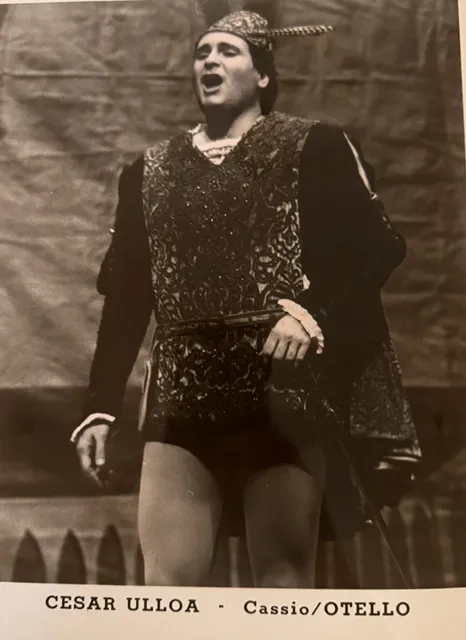
Ulloa as Cassio in Giuseppe Verdi's 'Otello.'
Landing the Dallas Opera, Ulloa says, "Gave me the opportunity to hear so many incredible singers up close. I was always listening, and that experience really helped shape my ear. I think it made me a better teacher because I learned to listen carefully to each individual voice and understand what was unique about it. Singers like Alfredo Kraus, John Vickers, Beverly Sills, Marilyn Horne and Jose Carreras—I'd always pick their brains about technique. But it was Marilyn who really heard me and was my inspiration and guiding presence throughout my life."
Horne encouraged Ulloa to audition for a two-year program at New Jersey Opera Theater, where she, along with singers like Franco Corelli and Jerome Hines, worked with the 10 chosen student singers. It paid, Ulloa says, "so I was able to quit my temp job and study there for two years." (One of his pre-opera day jobs was as the bilingual secretary for an executive at Lehman Brothers on Wall Street.)
Even as his performance career accelerated, "My passion was always teaching," Ulloa says now. "When my mother passed away, in her hope chest, we found a newspaper clipping from when I graduated from high school, and at the bottom it says, 'He would like to be a voice teacher one day.' I don't even remember saying that."
"But," he continues, "I was always very interested in the voice and how it worked to be able to produce sound that would carry over an orchestra without a microphone. I had every book on every singer and technique—I still have them—and I had all these incredible singers in my head from the first time I heard them while in the opera chorus, because I was always listening. Singing was this talent that came easy to me, but I'm probably a better singer now than I was after 32 years of teaching."
César Ulloa has shaped the sound of opera on every major stage in the world. What made him extraordinary wasn't just his ear—it was his refusal to let a singer's technique and their humanity be treated as separate things."—Voice faculty Rhoslyn Jones
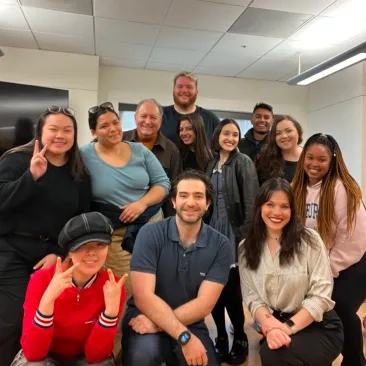
César Ulloa's 2024-2025 SFCM studio.
Jones, who matriculated through SF Opera's lauded Merola early-career program and now, like Ulloa, teaches there, continues. "What I notice most about his teaching legacy is how he stays with a singer through the years it takes to actually become an artist. SFCM, the Adler and Merola programs, and countless other top programs, along with this entire operatic community are stronger because he was in the room. His legacy isn't a list of names on the world's great stages—though there are plenty—it's the standard of care he set for what it means to teach."
Initially, in high school, "When I learned that the instrumentalists in the school orchestra were not going on tour, but the choir was, I decided I wanted more than anything to go on tour, too," Ulloa told OperaWire in 2020. "I loved it, both the singing and the touring." But in 1994, he decided, "I just didn't want to travel anymore after 15 years," and began his journey as a pedagogue.
"When I first arrived at SFCM in 2006 after I had already been teaching for around 10 years," Ulloa says. "I could not have imagined how profoundly this institution would shape my life. What began as a professional appointment soon became something much more meaningful. The Conservatory became a second home—a place of artistic discovery, lifelong friendships, shared purpose, and countless memorable moments that I will always treasure."
"One of the greatest privileges of my teaching career has been the opportunity to teach, mentor, and collaborate with so many gifted students, colleagues, and staff members," Ulloa says. "To witness young artists, discover their voices, develop their artistry, and grow into confident professionals has been both inspiring and deeply rewarding. Also, one of the greatest joys has been watching generations of my students go on to build meaningful, influential, and successful careers on opera stages, concert halls, and in teaching studios around the world. Their achievements have brought me immense pride and have been among the most gratifying aspects of my years at the Conservatory."
I willl remember so many things about Cesar and his time here at SFCM. Yes, he's a phenomenal teacher—and seeing students of his grace the major stages of the world is a testament to that. But more than that, almost every week, I would see him downstairs in the cafeteria sharing breakfast and imparting wisdom with a student. He cares about his students and gives so much of himself to them. It's inspirational."—Matthew Worth, Voice faculty
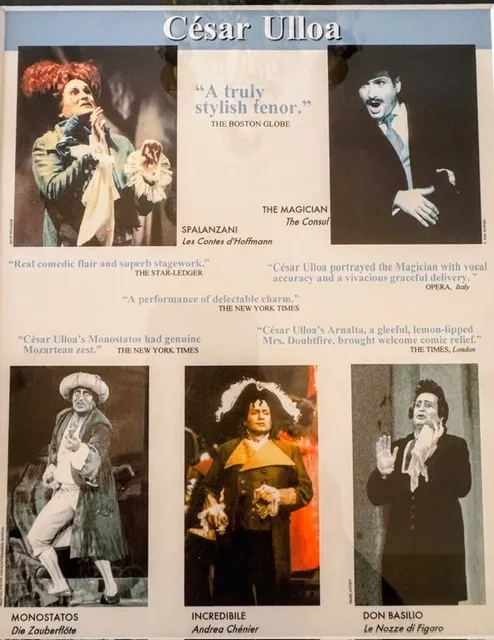
A selection of César Ulloa's roles over the years.
"The first thing I always listen to with a new singer is if they have something unique to offer," Ulloa explains. "A voice that's just not generic. And if they have that, then I listen to where the weaknesses are in the voice: Whether they're in tune, if they're breathing correctly, if they're supporting their voice. So I think, based on this, 'Can I help this singer?' I know this might sound sort of crazy, but I can hear where a singer is going to be two, three years from now, and where I can take them—I've always been able to do that."
Ulloa says he's always keen to stress with his students that the life of a professional singer is a demanding one.
"At a certain point, I always tell them, 'If there's something else you love just as much as singing, go do that.' Because this takes very hard work. You have to make sacrifices — relationships, family ... so much. It takes a lot. And it's hard to tell them when they're 18, 19 years old because that's their dream. But later, when they come in for their master's, you have to have that conversation."
Ulloa often helps his students navigate this difficult realization by sharing a story from his own life. "My mother always said, 'Oh, you have this gift from God.' Of course, I impressed my family. So I grew up thinking, 'Okay, I can sing.' But when I got to my first audition in New York, right across from Carnegie Hall, there were, like, four tenors who sang the Bohème aria with a high C, you know? And I was like, 'My God.' So I remember going outside and getting on the pay phone and calling my mom and telling her, 'You told me I had this special gift, but it seems like everyone in New York has my gift.'"
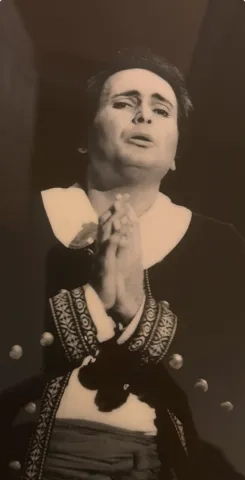
César Ulloa in 'The Elixir of Love.'
What Ulloa makes sure to emphasize for his students is, "You have to love going into a practice room and working hard for long periods of time. If you don't love that process, forget it—that's what you're going to be doing the rest of your life. You have to love this more than anything."
Browsing the ranks of singers who have studied with Ulloa, it's clear they listened. Among the SFCM alumni making waves in the opera world, Ulloa's students Amina Edris, Julie Adams, Eleazar Rodríguez, Efraín Solís, AJ Gluckert, Esther Tonea, and Kate Allen rank high.
"I felt like I've done my job," Ulloa now reflects. "My dream was to become a voice teacher, and now I have the privilege of mentoring these students and teaching them what I've learned from all the great singers I've encountered throughout my life. What I've developed in my own teaching is a way of working with each student individually—to discover what they do best, to understand what makes their voice unique, and ultimately, to help them find their own voice.“
Asked if the young version of himself who said long ago he wanted to be a voice teacher would be proud of the path he chose, Ulloa answers simply: "Yes, I definitely did the right thing."
Learn more about studying Voice at SFCM.