Explore SFCM's Rare Theremin with the Help of Theo Popov
Built by legendary synthesizer designer Bob Moog, the Conservatory's Big Briar 91A celebrates its 35th birthday this year.

Theo Popov and Leo Theremin.
After hours in the practice room focusing on fingerings, hand position, and technique, do you ever wish you could just play your instrument in thin air? Leon Theremin and his namesake instrument are there for you.
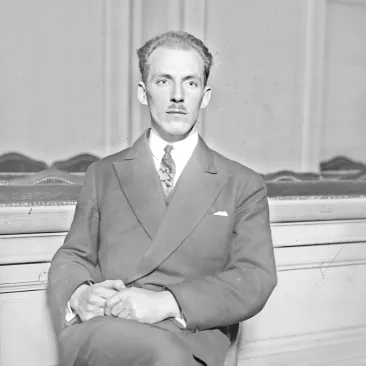
Leon Theremin in 1927 (Credit: National Library of France)
Though the theremin is (for the world of the orchestra) a relatively spry 106 years old, it's made a tremendous impact on how musicians across the world play, and think about, music. The first electronic instrument, it works by generating electromagnetic fields around its two antennae, which interact with the body's own electrical signals, allowing you to control the pitch and dynamics of its signal with gestures in the air.
"I find this instrument absolutely fascinating, not just because of its historical value, but because it's informed a lot of the thinking that electronic musicians have about the possibilities of generating sound from nothing. It doesn't have a keyboard, it doesn't have any controls except for your hands." Technology and Applied Composition faculty member Theo Popov says. "Because pitch is so important, it's also pedagogically useful for someone who wants to practice their musicianship. And with six octaves, it allows a modern composer to employ a much wider register than most instruments."
SFCM's theremin is a Big Briar 91A, created by Bob Moog, the synthesizer wizard whose early models introduced the world to electronic music. Moog was fascinated by the theremin from an early age, building his own at 14 and eventually launching a company around theremin parts and sales before creating his era-defining synthesizers. Made in 1991, the Conservatory's theremin is one of about 50 in that particular production line; a similar one was listed for sale by a Los Angeles music shop in 2025 for around $4,000.
Theremin was an electronics prodigy growing up in Russia: By the time he was a high school senior, he'd constructed a full-on laboratory in his home, complete with a million-volt Tesla coil. He was researching how to use radio waves to measure the properties of gas in 1920 when he noted his equipment was generating its own tone that reacted to his gestures. Theremin, a cellist, was fascinated by this accidental discovery and began working on his nascent instrument. By 1922, he was demonstrating it to Vladimir Lenin in Moscow, and by 1927, for Albert Einstein in Berlin.
Lenin, keen to show off the technological prowess of the Soviet Union, sent Theremin overseas to the U.S., where he delighted crowds with live demonstrations of the instrument, including in Carnegie Hall. He patented the instrument in 1928, and then secured a deal with RCA to manufacture and distribute it nationwide. Unfortunately, the relatively steep learning curve of the theremin, combined with its high price, and the unfortunate timing of the 1929 stock market crash, meant the instrument was dead on arrival.
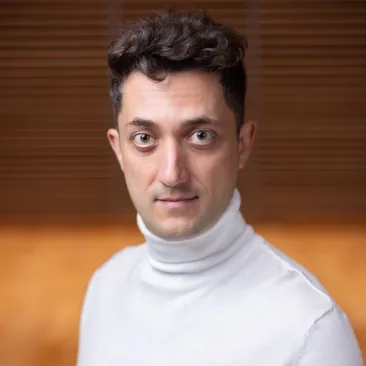
Theo Popov.
Despite working on several other inventions, including an early drum machine, Theremin's financial straits worsened, and in 1938, he made the then-scandalous decision to marry a black American ballet dancer, Lavinia Williams, which cost him most of his financial patrons and industry connections. Theremin decided to return to Russia at that point, though his timing wasn't ideal: His homeland was in the middle of Josef Stalin's political purges, and Theremin was falsely accused, arrested, and sentenced to the Siberian gulag. But the Soviets recognized Theremin's usefulness, and, though still a prisoner, he was taken back to Moscow and worked on aircraft and surveillance technologies. (One of his inventions, a hidden microphone called "The Thing," was embedded in a wooden carving of the Great Seal of the United States and hung in the office of the US Ambassador to Russia for seven years before being discovered.) Released in 1947, he went on to teach at the Moscow Conservatory.
But Theremin's instrument was saved by Hollywood rather than a conservatory or concert hall. Though some composers recognized the instrument's possibilities and composed specifically for it, the theremin gradually became absorbed into the language of film music: One early user was Dmitri Shostakovich, who included it in his score for the 1931 Russian film Odna. In the US, Miklós Rózsa was widely credited with popularizing the theremin for soundtracks, thanks largely to two enormously popular movies released in 1945: Alfred Hitchcock's Spellbound and Billy Wilder's The Lost Weekend.
Proto-horror films like The Spiral Staircase (1945) and The Red House (1947) furthered the association of the theremin with the darker side of cinema. But it was the "flying saucer" and sci-fi craze of the 1950s that tipped the theremin into cliche: Rocketship X-M, The Day the Earth Stood Still, and The Thing from Another World, released in 1950 and 1951, prominently featured it. Interestingly enough, for all of these films (and many more), the theremin was performed by one man: Samuel J. Hoffman, a violin prodigy (and podiatrist!) who'd acquired one of the first RCA theremins. Settling in Los Angeles and performing with groups built around the instrument, Hoffman was discovered when Rózsa found him as the only thereminist in the union who could read music. This began a decade-plus of film work, along with commercial instrumental records put out by the original US manufacturer of the theremin, RCA.
The theremin then warbled its way into pop music, most notably on the Beach Boys' 1966 hit "Good Vibrations," though that song actually features a copycat instrument invented by Paul Tanner. Other Sixties icons like Jimmy Page of Led Zeppelin, Brian Jones of the Rolling Stones, and Frank Zappa all used the theremin to varying degrees in their era-defining work.
The theremin, Popov says, "doesn't have to breathe, or take rests, so you can do pretty much anything you can imagine within that six-octave range. The possibilities really are endless, and it's just one of the many phenomenal tools we have here as musicians at SFCM."
Reserve tickets for Theo Popov's Faculty Artist Series recital on Nov. 16 at 7:30 PM, and learn more about studying Technology and Applied Composition at SFCM.