RJAM Guitarist Guests with SF, Oakland, and Minnesota Symphony Orchestras
Tri Pham wowed Oakland Symphony Music Director Kedrick Armstrong, who invited him to Minnesota to perform the same program.

Tri Pham, with SFCM faculty Matt Brewer on bass.
Roots, Jazz, and American Music guitar student Tri Pham had a busy four months from March to July, when he appeared first with the Oakland Symphony (OS) in March before traveling to perform the same program with the Minnesota Orchestra (MO) in June, and then getting called up to play with the San Francisco Symphony (SFS) for two nights of live-scored screenings of West Side Story in July. As if that weren't enough, he released a new album of original material, Interrelations, on June 26.
In Oakland, Pham played Brian Raphael Nabors' Hammond Organ Concerto, accompanied by fellow RJAM students Sean Walters McDonald ('27) on bass and Jaeden Lino Bamba Baclay ('29) on drums and Nabors himself playing the titular keyboard. First invented in the 1930s, the Hammond organ was originally marketed to churches as a cheap alternative to pipe organs and a louder alternative to pianos. By the mid-60s it had become synonymous with gospel music, and virtuoso organist Jimmy Smith took that a step further with a run of records that pioneered the organ trio, usually featuring a Hammond, guitar, and drums. (Dedicated organists can play bass lines with the instrument's foot pedals.)
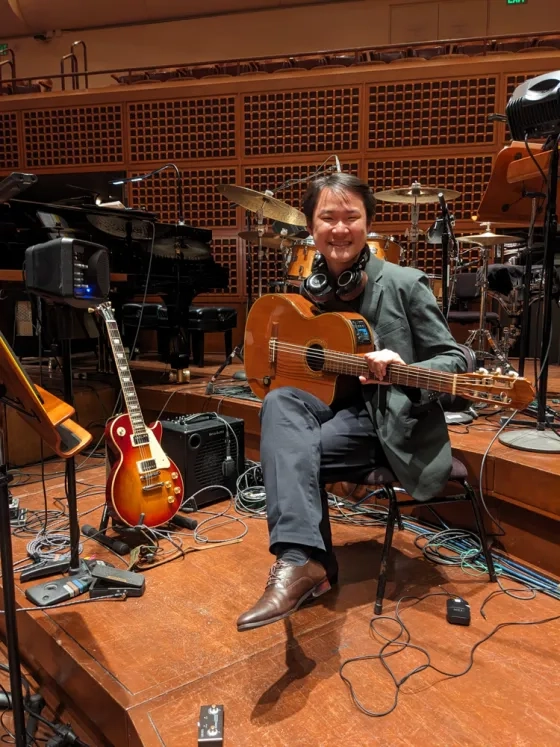
Tri Pham onstage at the San Francisco Symphony.
Oakland Symphony Music Director Kedrick Armstrong has a close relationship with SFCM and has taken the podium for SFCM Orchestra performances. Months after the Oakland performance, Pham was away at a jazz camp with spotty internet access, and, his last day there, after finally connecting, he saw an email reading "Minnesota Orchestra next week." Armstrong was conducting the Orchestra's Juneteenth celebration with Nabors performing his piece again, and had recommended Pham for the guitar slot when the local guitar player had to drop out.
Pham recalls their conversation: "She asked me, 'Do you know West Side Story?' I say, 'No.' Are you familiar with that music?' I say, 'No.' 'Well, do you want to play?' 'Yes.'" Pham picked up 52 pages of music for the two-and-a-half-hour film in four days of intensive study and hit the stage with SFS on July 9 and 10.
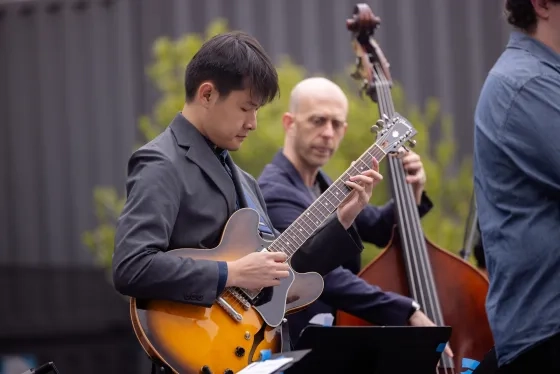
Tri Pham performs at SFJAZZ Festival.
Pham says his busy summer taught him that, "While I'm a student here, at the same time, I can think about my career as a working musician on these professional sessions, playing with an orchestra." Pham also maintains a studio of guitar students from 5-18 years old he teaches every Sunday, and, as previously mentioned, was, for months, also assembling Interrelations.
"I've been learning jazz since 2020," Pham says. "I learned a lot of theory, a lot of jazz standards, and then when I came to the US, I had more chances to play with good players, especially at jam sessions at SFCM and in SF. At one point, I said, 'What am I doing here? What's my artistic vision?'"
"I started focusing on interpreting standards," Pham continues. "Playing the same tunes with as many people as possible, and learning jazz vocabulary on guitar. One day, I thought, 'What is my voice, though?' And I think one of the easiest ways to find that is with composition, so I just wrote a few tunes."
Interrelations features Adam Torres and Jeff Brown on saxophones, EJ Brannan on drums, and Jonny Kaminek on bass. After just one rehearsal, Pham's group tracked eight tunes in a three-hour session, which were then mixed and mastered by Technology and Applied Composition student Paul Walker Davies in SFCM's Bowes Center studio.
As Pham writes in the album notes, "What began as a personal dream became possible entirely through friendship, trust, and a shared love for jazz …Interrelations is less a declaration than a gathering. Though produced under my name, this is not a traditional leader record, but a meeting of individual musical paths converging through shared emotion, listening, and improvisation. Each composition reflects a different perspective, yet together they form a single evolving dialogue, one rooted in connection, openness, and collective expression."
Learn more about studying Roots, Jazz, and American Music or Technology and Applied Composition at SFCM.