TAC Grad and SFCM Studio Coordinator Emma Markowitz to Helm Recording for Cabrillo Music Festival
Markowitz, who graduated in 2024, works as SFCM's Studio Coordinator and teaches in the Technology and Applied Composition (TAC) Department.

Technology and Applied Composition (TAC) grad and current SFCM Studio Coordinator and faculty Emma Markowitz is setting up shop in Santa Cruz in July as sound and recording engineer at the Cabrillo Festival of Contemporary Music.
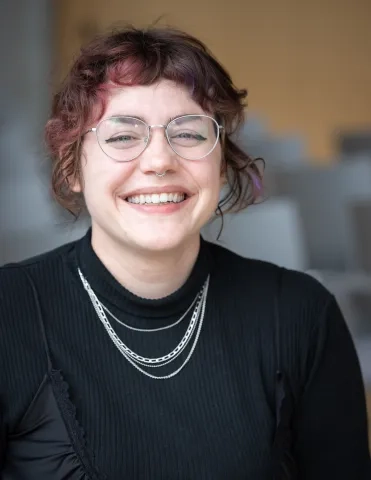
SFCM Studio Coordinator Emma Markowitz.
Markowitz, who graduated from SFCM in 2024 and has been working in SFCM's studios and teaching since, chalks up their career path to the time-honored tradition of saying "yes" a lot—for a time, anyway.
"There have been different eras of my career," Markowitz explains. "When I first started, I was like, 'I'm just going to take any gig I can find and do anything. I'm going to just work and learn on the job as I go.' So when anyone would ask if I would do sound for any kind of live show, I'd say yes. That branched into almost anything AV-related: For example, I started doing projection mapping after my class here."
"That was good for about two years, and then I thought, 'Okay, I need to stop doing all these things and narrow down the scope—so what do I really want to be doing?,'" they continue. "I really liked doing live sound and recording classical music, and I heard about Cabrillo from D. Riley Nicholson ('26 MM, Composition) who I did a recording session for about a year ago."
At Cabrillo, Markowitz is on hand for recording rehearsals and live performances as well as various workshops, lectures, and panels. This year, Cabrillo's festival, under Music Director Cristian Măcelaru, features four world premieres, eight West Coast premieres, and two U.S. premieres, among them is the West Coast premiere (and only second-ever performance) of Philip Glass' Symphony No. 15 ("Lincoln.")
"SFCM has really prepared me for classical music recording," Markowitz says. "I know I've mic'ed nearly every single instrument that's possible to use in this genre, so for almost any ensemble, I feel like I can figure out how to mic it correctly. The amount and range of different events we do prepare you for such a wide variety of experiences—not only with the technical side of things, but also from the communication side: Interacting with performers and figuring out their needs."
Markowitz identifies two stages in which students can get stuck. "There's the 'I have no idea where to start my career,' phase, which I solved by just doing a lot of different work. And I really would recommend that, at least for a little while. Saying 'yes' to everything will burn you out, but you can't know what you want to do—or what you don't want to do—until you do it."
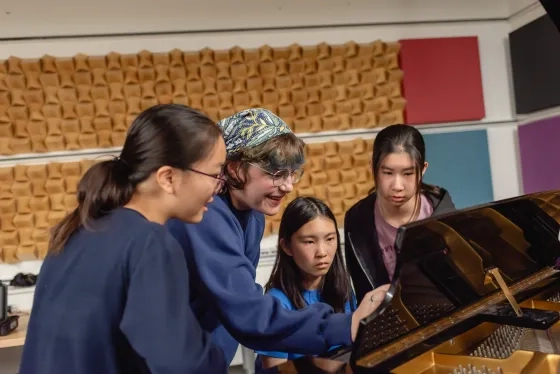
Emma Markowitz with Pre-College students.
"Then there can be this period where students feel like, 'I'm not going to do anything because I'm worried that I won't be prepared,'" they continue. "But that's what TAC is preparing you for: You have the capability to figure out something on the fly, even if you're not 100 percent prepared for it. You leave here with a lot of valuable skills, and there are always people who will need someone to run some kind of technical project that you can probably handle with what you've learned here."
Crossing over from the technical side of things, Markowitz identifies a big part of a successful recording engineer's role as "being the professional in the room." Their advice essentially boils down to "Don't panic," because, as they say, "If you're panicking, everyone else is going to panic. You're in charge of it, and people do rely on you for that, 'Everything is going to be okay' energy."
In situations ranging from bars to stages like Cabrillo, Markowitz puts that approach first. "Even if something is crashing and burning, I feel the number-one thing for a recording engineer is to be the person who should make other people feel comfortable in the situation. Artists want to feel like they can be artists and the sound person will handle the sound things. That's always my approach: Obviously I can have my feelings later about it, but in the moment I'm trying to act calm and create a welcoming environment."
Learn more about studying Technology and Applied Composition at SFCM.