Mason Bates Performs 'Mothership' with Googler Orchestra at Computer History Museum
Along with Bates' signature electronic elements, 'Mothership' features an unusual orchestral moment: improvisation.

Mason Bates.
The mothership has landed. Over 15 years after its original premiere, Mason Bates' Mothership came home, in a sense: Originally commissioned by the YouTube Symphony, the video site's parent company, Google, performed the piece via its employee orchestra in August at the Computer History Museum in Mountain View, California.
"The YouTube Symphony was this crazy, wonderful idea from YouTube to use their platform in a kind of elevated manner," Bates says. "At that time, it was sort of like a 'cats on skateboards' kind of thing, so they engaged Michael Tilson Thomas and that first year they played a piece of mine. They liked it so much that the second year, when the event was happening at Sydney Opera House, they commissioned me to write a brand-new piece." (In that debut performance, Tilson Thomas riffed on the well-worn Carnegie Hall joke—where the performance was held—by changing the punchline to "Upload, upload, upload!")
"I've balanced a career writing for traditional forces like orchestra or chamber music with stretching and expanding the medium at the same time," Bates says. "Mothership did two things at once in that spirit: It incorporated techno beats and sound design within the orchestra, and it integrated improvisation into a couple of passages. "That was the specific commission assignment from YouTube: They wanted to feature different kinds of players from beyond the orchestral field." For example, Mothership's premiere featured soloists on electric guitar, zheng, and bass guitar, while The Boston Modern Orchestra Project's 2015 recording of Mothership featured jazz pianist Jason Moran and guzheng player Su Chang.)
Bates was in New York with the YouTube team in the early stages of the project, and getting on the subway to head to a meeting with them, he recalls, "I was watching people come in and get off the subway car, and I thought maybe, 'Maybe this piece can work like that: The orchestra can be like a spaceship that is docked, but then these different visitors pop in and pop out."
"So instead of it becoming a piece all about improvisation, it became a piece about the orchestra as the mothership with these kind-of pop-up moments where I gave improvisers a little sandbox to do something cool," Bates continues. "Although I think it's recently been overtaken by Philharmonia Fantastique, for a while it was my most-performed piece, not just because of the electronica elements, but because I provide lead sheets. So you get, for example, the Baltimore Symphony featuring a cigar-box guitar as a soloist."
Bates adds, "What I try to pass along to my Composition students at the Conservatory is that you can do a lot with our medium with an orchestra or in an opera house or with chamber music, but you just really need to understand how it works. But it's now possible for orchestras to do something like Mothership that can become one of the most-performed new pieces of the century, it just needs to have options that can easily be done in the framework of their rehearsal weeks."
The Googler Orchestra dates back to 2016, when it was founded by multi-instrumentalist software engineer Derek Wu. After about a year at Google, he started to become aware of how many musicians he counted as coworkers.
"These were either people who played music back in high school and wanted to pick it back up again, or those that have maybe pursued it professionally at some point but then decided to come into the tech world," Wu told the San Francisco Chronicle this month. While the ensemble's debut featured only 30 musicians, it now features twice as many, and over 600 Google employees have played in the Orchestra at least once in the subsequent 10 years.
To the Chronicle, Bates compared the Googler Orchestra to the Longwood Symphony Orchestra, a Boston ensemble founded in 1982 by Harvard Medical School faculty. "I think it's good to be reminded that you can play in an orchestra even if you're not a professional musician. I think maybe the world would be less involved in 10 wars at the same time if everybody did that."
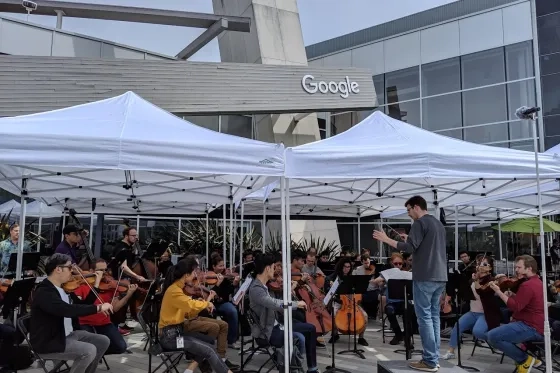
The Googler Orchestra performs at Google HQ.
Bates says that between his works like The ®evolution of Steve Jobs, Mothership, and Mercury Soul—an organization he cofounded in 2008 that combines classical music and electronica in alternative venues with immersive stagecraft and elaborate production—"I have more relationships with the tech community than probably any other composer."
He continues, "The more digital the world gets, the more valuable the spaces musicians create become. And I think that there are things about those spaces that can evolve, particularly on the level of concert presentation, if we're going to bring people to us."
To that end, Mercury Soul will be staging its largest performance yet on November 13 at San Francisco's iconic Grace Cathedral, featuring multiple stages and visuals tailored to the space. Bates will intersperse DJ sets (under his moniker DJ Masonic) with classical works performed by an ensemble that consistently features SFCM students. Tickets will be available soon at Mercury Soul's website.
Learn more about studying composition at SFCM.