How Warren Wolf's Classical Training Informed His Jazz Musicianship
Wolf's October Faculty Artist Series recital is a duo set with fellow SFJAZZ Collective member Edward Simon on piano.

SFCM faculty Warren Wolf.
Though Warren Wolf is ostensibly a jazz vibraphonist, if you're wandering through SFCM's Bowes Center and see him working with one of the Roots, Jazz, and American Music Department's small combos, you could be forgiven for thinking otherwise.
That's because Wolf is equally at home sitting down at a piano, drum set, or standing behind an upright bass, which makes him an invaluable resource to the Conservatory's musicians: Wolf is basically a jazz trio unto himself, capable of addressing a given ensemble's rhythmic, harmonic, and melodic angles.
Much of this has to do with the intimidating practice routine Wolf's father set him up with beginning when Wolf was 3 years old: 90 minutes a day, five days a week, divvied into a half-hour on drum set, piano, and vibraphone. "Now, within those 30 minutes," Wolf explains, "Monday could have been, like, 'jazz day,' then Tuesday was 'classical day,' Wednesday 'pop music day'—tunes to stay current in a working band—Thursday maybe Motown or other classics, and then Friday back around to jazz."
Wolf's dad, with whom Warren shares a name, was, as he says "the pinpoint for everything." Though the elder Wolf's "day job" was teaching history in the Baltimore City public school system, his father was an actively gigging musician in the Baltimore and Washington, D.C. area, and their home featured a drum set, vibraphone, and synthesizer array in three corners of one room. But, Wolf says, "the majority of my training coming up was honestly all based around classical music" largely via the Peabody Institute's preparatory division and Leo LePage, Baltimore Symphony percussionist from 1967-2000.
Wolf progressed to the point where he was playing with the Symphony—"One that vividly comes to mind was playing the Pied Piper Fantasy with James Galway [the flutist who commissioned that concerto from John Corigliano]"'—and playing flute, piccolo, violin, and cello pieces transcribed for marimba. "But while I was doing all my classical stuff," Wolf recalls, "I was also trying to figure out improvisation in jazz, because my dad was just adamant that I understood—not necessarily jazz—but how to improvise. And I just couldn't get a handle on it. So now that I'm teaching exactly that, I do think a lot of it has to come with maturity."
Meanwhile, Wolf says, "sometimes my dad would bring me out to his gigs and say, 'Let my boy play.' But when I say that he had a jazz band, this wasn't like, Coltrane. They played stuff that was more of a party vibe, like Anita Baker, the Yellowjackets, Spyro Gyra—they never really dealt with swing feel, the whole broken-triplet thing." Also, he adds, "some of these club sets around Baltimore weren't starting until 1:00 in the morning, and then they'd play until 5:00. So I couldn't go out all the time, because I had school."
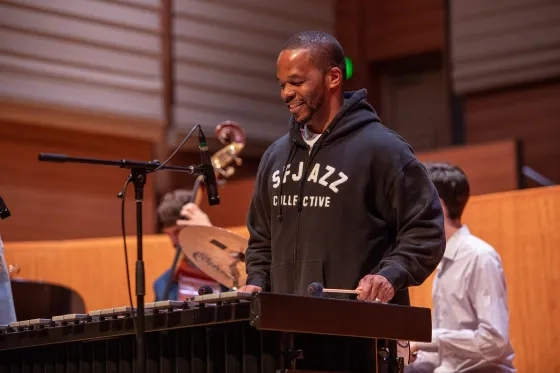
SFCM's Warren Wolf.
"But I honestly look at my career as in two different halves," Wolf explains. "Until I was 17, there was the classical half, and I was being trained for a symphony position, because when I was at Baltimore School for the Arts, they made me switch over to study with John Locke, who's been with the Baltimore Symphony since 1988."
Slowly but surely, though, Wolf gigged more regularly in the jazz world via his high school band director's big band, among others, and in his words, "as I started to get better at playing jazz, I decided to leave classical alone, and that was pretty much it." But he adds, "it wasn't just jazz: I was focused on playing more popular music, like R&B, gospel, hip-hop, and everything else."
Wolf is also something of a rarity in the jazz world—especially on the East Coast—in that he's never once lived in New York: "That's what you're supposed to, but I decided to do something different." His association with bassist Christian McBride, one of the most visible contemporary jazz musicians, didn't come from New York either. "The only camp I've ever done in my life was something Christian leads called the Jazz Aspen Snowmass Summer Sessions, and I played for him as a student," Wolf says. "He heard me and said, 'Man, you sound really good. Give me your number.' But that phone call to join his band didn't happen for at least six years, when he called me to play a week at the Village Vanguard in New York."
For Wolf's Faculty Artist Series recital, he decided to pair with his fellow SFJAZZ Collective member and fellow RJAM faculty member, pianist Edward Simon. Their program for the evening will be duets in the vein of Gary Burton (vibraphone) and Chick Corea (piano), whom, over the course of several decades, recorded multiple albums together, most notably 1973's Crystal Silence.
And as far as his work with RJAM's student combos, Wolf says, "I just love working with bands' rhythm sections. From vibraphone, I can translate that over to horn players, soloists, but piano, bass and drums, I think I have a good balance right there that helps me work with everybody. I try to be very honest with the students and just tell them what I think that they should do and what they should listen to. Students in general, I think they should listen a little bit more to a lot of older recordings—and I'm not saying they have to play like them— but for guidance, to take what they like and mold it into their playing. In improvisation, your ears are literally like your best friend."
Learn more about studying Roots, Jazz, and American Music at SFCM.