'The Authentic Is Going to Matter:' SFCM Welcomes Students with 2026 Convocation
The Conservatory honored Board of Trustees Chair Timothy W. Foo, faculty member Sharon Mann, and student Mumtozbegim Ochilova.

From left: Zeke Sokoloff, Wonhee Bae, Jennifer Culp, and Dimitri Murrath.
SFCM has officially welcomed its class of 2031.
The Conservatory rang in the Fall 2026 semester with its September Convocation by honoring some of its own and—of course—playing music.
Voice student Mumtozbegim Ochilova was honored with the annual Presser Undergraduate Scholarship. "Mumtoz is one of the most exceptional students I have had the privilege to teach," faculty member Rhoslyn Jones said of Ochilova. "Her musicality, work ethic, and intellectual curiosity set her apart, and she brings the same generosity and leadership to her peers as she does to her own artistry."
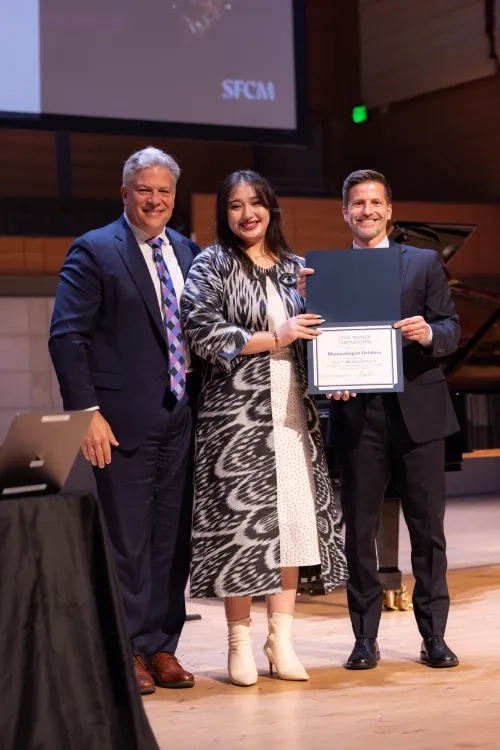
From left: SFCM President David Stull, Mumtozbegim Ochilova, and Dean Ryan Brown.
"She is fully deserving of the Presser Award, and I give her my strongest and most enthusiastic support without reservation," Jones added. "I am sure that every single person in the school who has ever met Mumtoz would agree." The award is named for Theodore Presser, a self-made musician whose namesake company is the longest continually operating music publisher in the United States. The Presser Foundation supports music organizations, undergraduate and graduate music students, and retired music teachers.
Next, the annual Sarlo Family Foundation Award for Excellence in Teaching went to longtime SFCM Piano and String and Chamber Music faculty Sharon Mann. The highest award honor to a faculty member at SFCM, the Award was established by George Sarlo, who joined the SFCM board in 1988.
"I have to say, in my 35 years of doing this kind of work, I have never worked with a colleague like Sharon Mann," SFCM President David Stull said. "The privilege of being able to make this recognition of her work today is extraordinary."
Mann, who began teaching in San Francisco 25 years ago, received the United States' first-ever doctorate in piano and chamber music (from Northwestern University). Echoing Stull's comments, Piano Chair Yoshikazu Nagai said, "Professor Mann is much more than a great teacher. She is a caregiver to all her students and colleagues. Thank you, Sharon. I'm grateful to you for all that you have given to us as an institution and most of all for your friendship. Missing you always and wishing you nothing but sunshine."
"I owe an enormous debt to my teachers, who put up with me long enough to make me into someone so that I could put up with you long enough to make you into someone," Mann quipped in her acceptance speech.
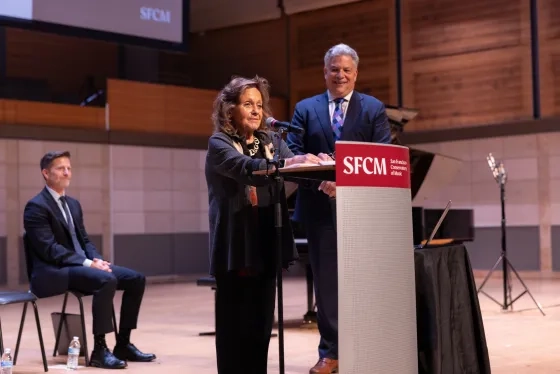
Sharon Mann and SFCM President David Stull.
"A studio is a kind of place of alchemy," she continued. "Of course, I will remember mentoring. I will remember raising your bar. I will remember teaching you how to practice. But there is a magical possibility of collaboration between a young mind and an old mind. And I remember thousands and thousands of fleeting moments, some of them memorable, some of them pivotal. Always a collaboration. Am I teaching you what I know, or teaching you what you don't know?"
"There's no syllabus, by the way, for making artists," Mann concluded. "In that little place, magic happens. I will always love that. I've worked in this beloved place for many decades. This is the place where people become musicians, and you know, I can't think of a better way to spend a life."
Violin student Zeke Sokoloff then joined faculty members Jennifer Culp (cello), Wonhee Bae (violin), and Dmitri Murrath (viola) for a performance of the fourth movement of Antonín Dvořák's String Quartet No. 12 in F major, Op. 96, nicknamed "the American Quartet," and inspired by the composer's stay in Spillville, Iowa.
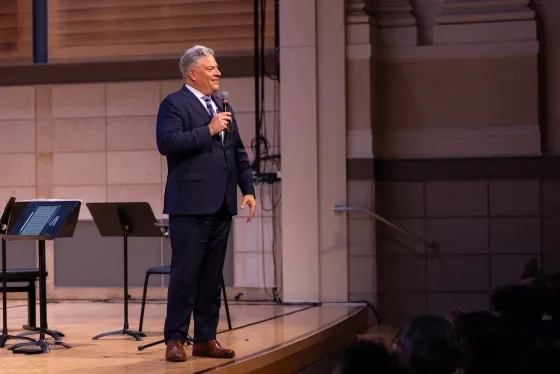
SFCM President David Stull.
In his remarks, Stull told the students assembled in SFCM's Caroline H. Hume Concert Hall, "you're doing exactly what you should be doing. For those of us who studied music, I don't think we ever really had a choice."
"I just think we knew we loved it so much that we were going to do it no matter what," he continued. "That's called commitment, passion, and resilience. You're gonna need those skills in your lifetime. The things that you were taught as a human being through music are the most valuable skills you're gonna need to be successful in life, period. I guarantee you that that's true."
"If you look at the world today, it's very easy to become discouraged," Stull allowed. "Politics, artificial intelligence—-all of these things that are coming our way, they will prove to be very difficult challenges. But within that frame, there are going to be opportunities."
"I'm here to say something to you as the president right now, the authentic is going to matter. Playing authentic music for authentic people is going to matter. Human beings are desperate for connection right now. They're desperate for community. They're desperate for artistry. They want to have a human story, and they want to stop being divided from one another."
"As artists, we have this charge," Stull said. "It is on us to bring our communities together to tell these human stories. People are not interested in AI slop. What they want is to know, 'I'm traveling through this life, and this person on the stage in front of me is going to reflect back to me the experiences I know I'm feeling right now.' That's what art does. It is critically important. It's actually essential to who we are."
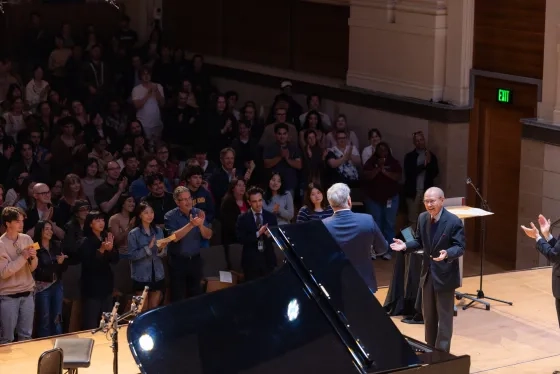
SFCM applauds the Chair of its Board of Trustees, Timothy W. Foo.
Stull concluded his address by announcing that SFCM's String and Chamber Music Department will be renamed in honor of the Chair of the Conservatory's Board of Trustees, Timothy W. Foo. Foo, who was born in Hong Kong, traveled to Oregon to study music before winding up in San Francisco real estate. He would become one of the Conservatory's most important allies, facilitating its move from Ortega Street to 50 Oak and helping to finance SFCM's newest building, The Ute and William K. Bowes, Jr. Center for Performing Arts. Among many other things, Foo's contributions also ensured that the Conservatory weathered the COVID-19 pandemic without having to lay off a single staff member.
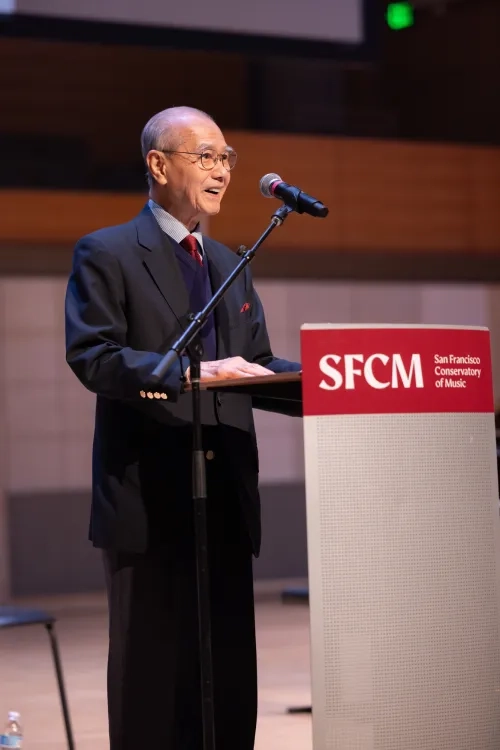
Timothy W. Foo.
"I've never worked around a person of more integrity, more grace, more commitment," Stull said. "I've never worked around a greater musician, because in his heart, Tim is all music. He is a brilliant CEO, but he's given his time, his energy, his effort, and most of you never even would have known his name. Yet, everything we see and enjoy within the Conservatory's walls is because he, like many heroes before him in extraordinary ways, advanced this place."
After a standing ovation had subsided, Foo joked, "David knows me well enough to know that I shy from this kind of thing. Really, I do. And if I had known what he was going to do—I would not have showed up."
But, he continued, "Thank you to all of you very much, because it's been my privilege and given me a lot of joy to be involved in the Conservatory; to see it grow and become what it is today. And it could not have been done without the board, the faculty, and its leadership."
"I played a little part in it," Foo concluded. "And I get a lot out of it, frankly. I've had more fun doing this than in all that I've done before. So thank you for making it possible for me."
Piano faculty Garrick Ohlsson closed the ceremony with a performance with two of the intermezzos from Johannes Brahms's Six Pieces for Piano, Op. 118. Noting, "I have to warm up," he opened his performance with a reharmonized rendition of "Happy Birthday" in honor of Foo.
Learn more about studying at SFCM.