Two Stars, One Sister: How SFCM's Dual Leads Sang the Title Role in 'Suor Angelica'
As Artist Diploma students, Kaya Giroux and Claudia de Lourdes Díaz were guaranteed the lead in SFCM's Fall 2026 opera.

SFCM's dual-cast Opera & Musical Theatre productions ensure as many Voice students get a chance to sing as possible, with those in the Artist Diploma program guaranteed a lead role. The students sharing these roles embark on a shared artistic journey from casting to performance: For SFCM's November production of Suor Angelica, the titular nun was played by both Kaya Giroux and Claudia de Lourdes Díaz.
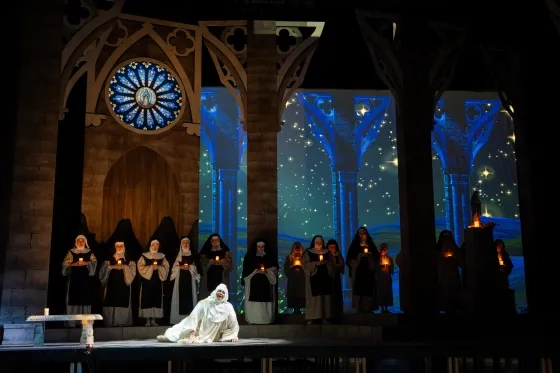
Neither of the two grew up listening to opera. "My dad's only real frame of reference for it is the scene in The Shawshank Redemption where 'Sull'aria ... che soave zeffiretto' plays," Giroux says, adding, "I wanted to be like a country music singer." Díaz adds, "Nobody sings in my family. Nobody has a musical bone. Can't even tune a note, it's absurd. But I grew up around a lot of music, like, salsa and boleros and classical music. I've just always said opera chose me."
Giroux calls seeing Madama Butterfly at Pittsburgh Opera her defining moment. "When I heard that for the first time, I was like, 'Oh my God, they're doing that without a microphone? They're singing over that huge orchestra? I remember feeling all of the goosebumps at the ending , and just being like, 'Whatever I just watched, that's what I need to have happen.' So Puccini's long been like my guiding star."
For Giroux, the casting has extra relevance given her previous roles at SFCM. "The first year I was here, we actually did Gianni Schicchi, which is the first of the trio Suor is from, so I think it's very full circle."
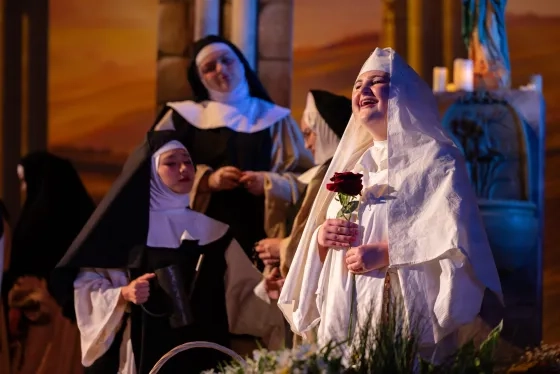
This performance was Díaz's second time playing Angelica, and third time overall performing the opera. "Now that I have a bit more control of my technique and my instrument, the role feels less like a straitjacket and more like a nice flowy skirt, Díaz says. "It fits me like a glove, and I know that every time I get the opportunity to sing it, it's gonna be better and I'm gonna discover new shades of colors to paint her with."
Díaz said she was "in awe" watching Barbara Frittoli in Suor Angelica at the Metropolitan Opera in 2007. "I was just crying and sobbing and thinking, 'How am I gonna do that?' As a spectator, you can feel all the emotions, but once you're in the middle of it performing it, there's a beautiful balance of how much I can permit Claudia to feel vs. how much Suor Angelica does. I remember talking with one of my mentors, Justino Diaz, and he told me, 'It is not your job to cry. It is the audience's job. This is not all about you, Claudia.' He told me to know where the line is, and cross it, so that way when you're back at the next rehearsal or performing, you know where that line is, and you know how far you need to go."
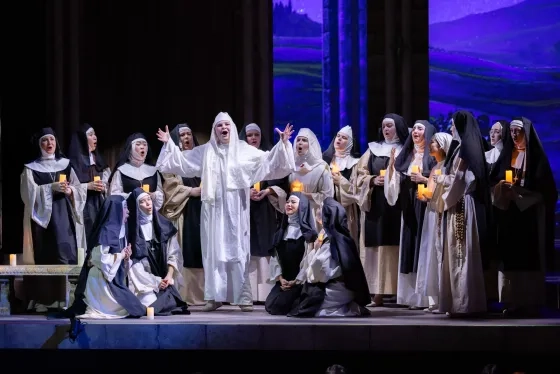
Giroux, who studies with Susanne Mentzer, sized up the role like a boxer from the moment her casting came through. "You have to be vocally in your right pocket to get through. For me, that looks like going through line by line and, and being sure of every registration—especially when we dip down low as much as we do in this role. So just looking at it like, 'Why would she put it in chest here? Why would she sing in a mixed registration here? Why does she go up to that high note?'"
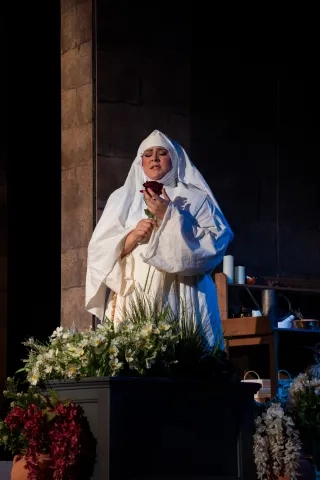
She also worked on prepping the text separately. "In the back of my rep binder, I printed out the Nico Castel libretto, so I could just look at what each word meant and review that every day separately from the music. That way, I know what every word and line meant."
Working with Rhoslyn Jones on Angelica, Díaz drilled down on technique. "I'm very emotional, and I love to just lose myself in the music and the character, so having that technical anchor is really essential," she says of Jones' instruction. "It's good to have a guide telling you, 'Okay, your tongue is doing this and this when you get to this part of your voice, so you need to do X, Y, Z.' You know, I'd be singing for her, and she'd ask, 'What happened in this measure?' and I'd think, 'My tongue went backwards, and then my jaw went down, and my soft palate didn't raise.' Because I was thinking about the emotion. But it has to be, 'Don't think about the emotion. Puccini already took care of that. Just focus on what your voice needs to do and how your body needs to be grounded and connected from the tip of your toes until to the end of the last strain of hair on your head."
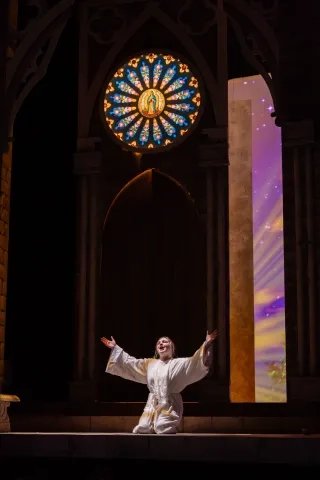
"Being someone who really wants to be a Puccini specialist," Giroux say, "as young sopranos, we watch Madama Butterfly and talk about, like, a very specific poised way of moving. And this is not dissimilar to that, but I look at it as kind of a training ground. It's only an hour, it's not three hours where you're onstage the whole time, so it's a more manageable way to train that poise and then also be able to fully let it go the moment at the end: That's where all everything comes out, everything that the character has been holding on to for seven years."
Díaz approaches her character's movements with the same rigor she does the vocals. "In this role, I'm crawling, I'm gasping for air, I'm emotional, I'm falling on the floor," she says. "And I have to find ways to continue singing without the emotion and the physicality of the role getting in the way. So throughout the rehearsal process, I know my marks, and I know when I need to stand or, or pose a certain way or land a mark in a certain way before a big phrase, so that way my body is connected fully and my voice and my sound is not disconnected."
Díaz delivers a mini-lesson in opera breath technique: "'Stacking is when you've been inhaling too much oxygen and not letting out enough carbon dioxide, so that your brain tricks you into thinking you have enough air, but you don't. And it happens when you're not fully like expanding your lower body into getting that good singer breath." She continues, "Because you're doing a bajillion things at the same time, your brain goes into overload and tells you you have enough air, but then when you go out and sing, you don't, and then the rest of your body isn't aligned with your instrument."
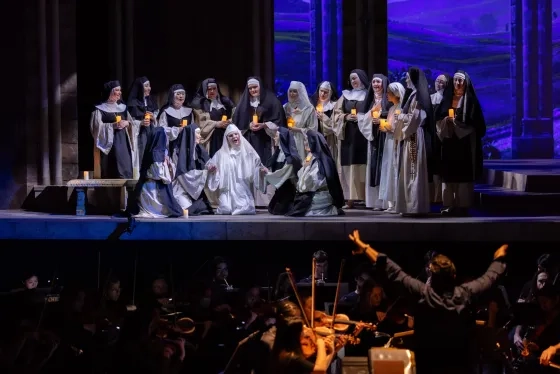
This becomes exponentially difficult as the character's movements become more dramatic. "Crawling around the stage, I know how many measures before I need to be at my next mark," Díaz says. "I have five measures, so crawl one beat, for two beats. But still stay in character and be ready to sing. That's what rehearsals are for; you get notes like, 'You're crawling too soon' or 'You're crawling too late, and then you can't breathe, and then you don't have enough time to hit that high C.'"
The two Angelicas supported and inspired each other on the path to performance. "What I like about working with Claudia as my double is that she's done this before," Giroux says. "But this is the first time I'm doing it. And she has such a clear vision of who she thinks the character is and what she's been through. Mine is completely different, of course, but both can be true."
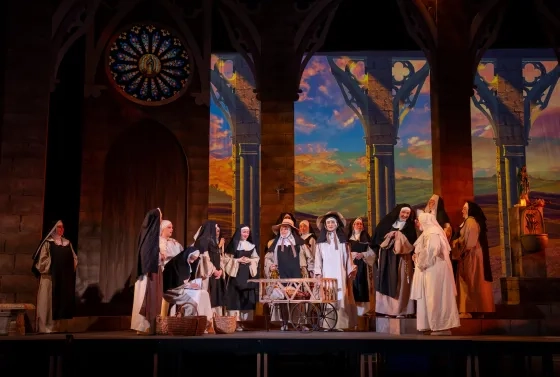
"We're apples and oranges in terms of who we are as artists, Claudia and I," Giroux continues. "But it's so lovely to get to work with somebody I respect so much, and we can both sing the same repertoire in completely different ways; it feels like the dynamic duo has taken this on. It's just, 'Okay, you do your thing!' We tap in and we tap out."
"I love the rehearsal process," Díaz says simply. "I love the people that I'm working with. I'm learning things about myself. I'm learning things about the music that I didn't know. I just ... I love opera. What a ride and what a joy and what tragedy, really—what an honor."
Learn more about Opera and Musical Theatre productions or studying Voice at SFCM.