International Pop Mingles with Mozart and Broadway at Craig Terry's 'Beyond the Aria'
Terry's genre-agnostic singer showcase debuted at SFCM in 2025.

SFCM students at Craig Terry's 'Beyond the Aria' in 2026.
SFCM singers weren't just Beyond the Aria at SFCM—they were past borders.
Craig Terry's successful showcase returned to SFCM in September after its 2025 Conservatory debut with a program that reached beyond Tin Pan Alley and the European canon to feature composers from Cuba, Mexico, and Taiwan. Terry's series is enormously popular in Chicago, where he serves as the Ryan Opera Center Music Director at the city's Lyric Opera, and as an Askonas Holt artist—part of SFCM's Global Creative Alliance—Beyond the Aria has made its way west via SFCM.
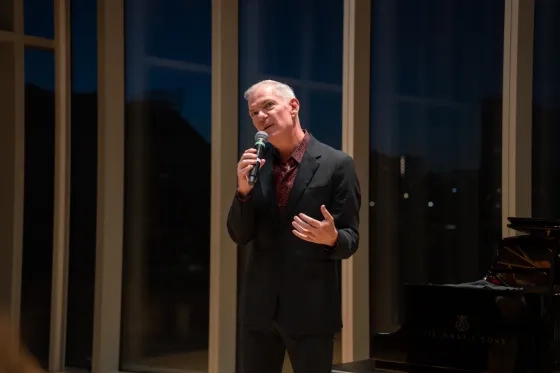
Craig Terry at SFCM in 2026.
Voice Department Executive Chair Richard Cox says that for this year's edition, no guest artists were featured, to keep the focus entirely on Conservatory students. (In 2025, Christine Goerke and Hugh Russell were featured.) And while last year's event included songs from the 20th-century pop music canon, like Leonard Cohen's "Hallelujah," this year's program reached further afield. The audience heard not only songs from the Great American Songbook, but also works from Mexican composer Manuel Ponce, Cuban composer Ernesto Lecuona, and "Cantopop" singer Chen Huanchang, whose song "Intimate Lover"—performed as a duet by Krystal Mao and Zhilun Liu—is most associated with singer and actress Anita Mui, once dubbed the "Madonna of Asia." (Huanchang is from Taiwan; "Cantopop" and "Mandopop" are language-based portmanteaus for pop music in Mainland China, Hong Kong, and Taiwan.)
The evening's multi-genre approach, Cox says, is "what the Voice department is already doing and will continue to do: Give students cross-training opportunities to broaden their artistry. The program is very much based in classical vocal technique, but seeing how that applies to other genres gives many more opportunities to our students."
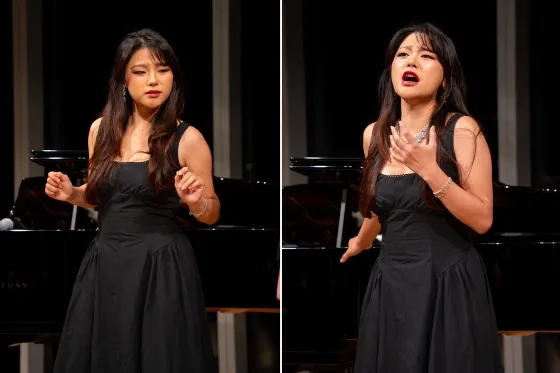
Angelina Yi performs at Craig Terry's 'Beyond the Aria' in 2026.
Beyond the Aria, he adds, is a conscious throwback to a more genre-agnostic style of performance. "This really is an evolution of what a traditional, typical art song recital looked like in, say, the early 2000s," Cox explains. "After the financial crisis of 2008, many performers lost the opportunity to do a recital tour every year—suddenly it went down to maybe one or two dates. So audiences began to crave more variety in the programming of these limited runs, and Craig began to think about how to stage these evenings in the tradition of the old variety shows, like Laurence Welk or Ed Sullivan's shows. Those mixed genres all the time: You'd have Marilyn Horne singing a trio with Bob Hope and Eileen Farrell on The Carol Burnett Show, for example."
Professional Studies Certificate soprano Angelina Yi grew up loving musical theatre, but began singing opera in high school, so the program's variety appealed to her, even if she felt slightly intimidated stepping out of her familiar repertoire.
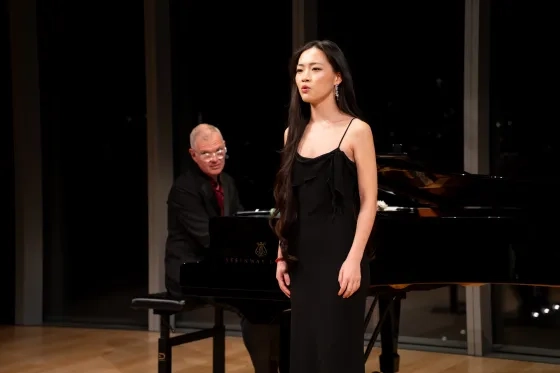
Krystal Mao in Craig Terry's 2026 "Beyond the Aria' performance.
"'Júrame' was arranged a little differently than the original composition," Yi, who studies with Rhoslyn Jones, says. "It was definitely a lot more jazzy, with a lot of improv going on with the piano. I'm so used to listening for the piano cues from the sheet music when it comes to singing my usual rep, but Craig was playing different voices or different rhythms every time." But ultimately she says, "It ended up feeling like I was actually collaborating with him, because I had to listen more to the feel of the music and the vibe he was going for."
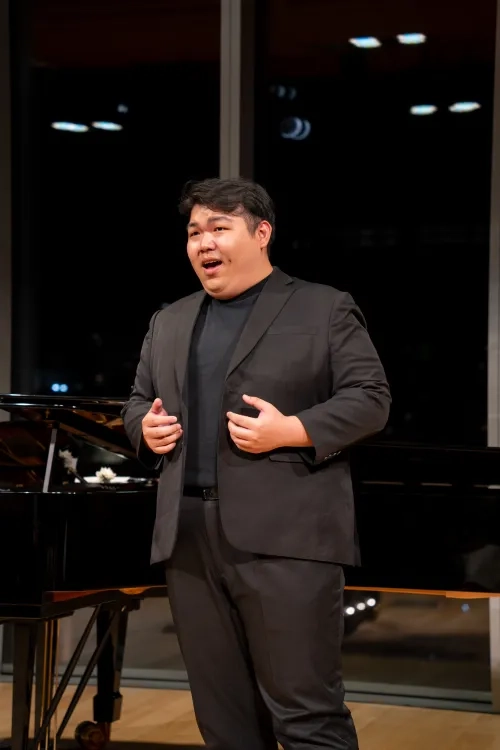
Sheng Feng Chan sings at 'Beyond the Aria' with Craig Terry in 2026.
Terry is "very enthusiastic about music," Yi continues. "It was really nice working with him because all the rehearsals were later, and very long. He had just flown in, and then he was with us from the morning to like, 7:00 pm. So I did ask, 'Aren't you tired?' And just said, 'No.' He enjoys working with young musicians and just loves making music, and that really made me more excited about working with him."
Tenor Sheng Feng Chan was on similar ground to Yi; he sung the title track to Because You're Mine, written by Nicholas Brodszky and Sammy Cahn, calling it "one of those really romantic and luscious pieces, and I haven't really sung stuff like that before," and admitting he was "actually really scared to sing musical theater."
But Chan says that working with Terry helped him get over that reservation. "I didn't know what to expect going into our coachings, but when I went in, he was really pumped up about doing the song. He's just a really passionate person, and it, and it comes through: He kept throwing ideas at and encouraging me to explore a lot of possibilities with the song."
At the piano, Terry, Chan continues, "is just so virtuosic. I remember him explaining he used to learn everything by ear, so whatever he plays now is just an accumulation of everything he's done, and he's just so good it always feels really right. I felt really secure with him playing the piano."
Chan studies with SFCM's Frederica Von Stade Distinguished Professor of Voice, Catherine Cook, and says she and Terry share a key quality: "The way that they describe things and the way that they teach, you can really tell that they love what they're doing, and I think it's always so inspiring when teachers are able to be like that."
Soprano Krystal Mao grew up in Fremont with Chinese immigrant parents and was excited to sing the Huanchang piece. "Honestly, it was so nice to be able to sing something in Mandarin," Mao says. "We did talk about it with Craig, and he was so genuinely passionate about it. He told us that somebody introduced him to this piece while he was in China some time ago, and I thought it was so nice of him to bring it here, because there are so many Chinese international students at this school, especially in the Voice Department. And of course, being in the Bay Area, there are so many Asian immigrants and Asian-Americans here, so I think it's really important to bring music that represents that to SFCM."
Chan and Mao both underscored how much they enjoyed seeing their peers pushed to explore outside of their respective comfort zones.
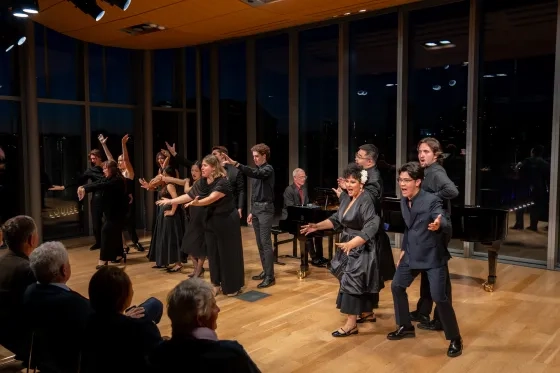
SFCM students perform in Craig Terry's 'Beyond the Aria' in 2026.
"I remember looking at the other stuff that was assigned to my friends, and I thought it was a really good mix," Chan says, "and finally being able to listen to them during our dress rehearsal, it showed off everybody's strengths really well. I think it's so amazing how people can sing both opera and musical theater; they're just this total package."
Mao adds, "I think that was the best part. I was like, 'Whoa, I had no idea you could sound like that. You already sound amazing singing opera, but you have this whole other side of you that I've never heard before, and now I wanna hear more of it.'"
Learn more about studying Voice at SFCM.