Everything You Didn't Know About Prokofiev's 5th Symphony
Prokofiev returned to Russia in the midst of Josef Stalin's political purges in Russia, finishing the Fifth in the later years of WWII.

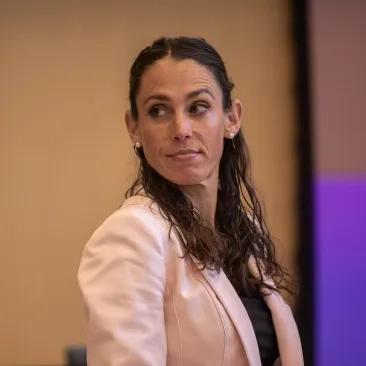
Sergei Prokofiev and Rachel Vandagriff.
SFCM's Fall 2026 performance season opens with the Conservatory Orchestra performing Sergei Prokofiev's Symphony No. 5 under the direction of Music Director Edwin Outwater.
It's relatively well-known that the premiere of the symphony—conducted by Prokofiev himself in what would become his last public performance—was delayed until the sounds of the Russian army crossing into Germany near the end of World War II had faded. But, chair of the Music History and Literature Department, Rachel Vandagriff (right), helps dig deeper into the context and history surrounding the composition of the piece.
Prokofiev left Russia during the Revolution in 1918, settling in France not as an exile, but "as a kind of ambassador of larger Soviet culture, at least from the Kremlin's perspective," Vandagriff says. Like Igor Stravinsky under the auspices of Sergei Diaghilev, Prokofiev composed for the Ballets Russes; Stravinsky was supposed to have called Prokofiev's first ballet for Diaghilev, 1915's Chout, "The single piece of modern music I could listen to with pleasure."
Prokofiev returned to Russia in 1936, though Vandagriff says, "there are a lot of questions about why he did that." She continues, "There's the not-very-gracious idea that he thought, by moving abroad, he was going to be the preeminent expat Russian composer—but Stravinsky ended up getting that mantle. Prokofiev was also an excellent pianist, so it's possible he also thought, 'I'll be the Russian pianist abroad,' but then Sergei Rachmaninoff received that mantle. So in moving back to Russia, he might have thought he could become the preeminent Russian composer, but by that time, Dmitri Shostakovich had taken that position." One of the simplest—and therefore most-circulated—ideas is that, owing to the factors Vandagriff cites, Prokofiev was increasingly dependent on Kremlin funding, and may have felt obliged to return home as a gesture to his benefactors.
But Prokofiev's return unfortunately coincided with the nadir of Josef Stalin's political purges in Russia. "It's the height of people being sent to the gulag, of the secret police, of informing on other people. Maybe Prokofiev didn't really know what was going on—or didn't believe it—but when he moved back, the regime really valued him." Nonetheless, he became subject to the autocratic regime and its whims.
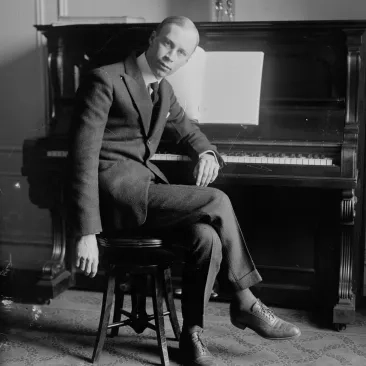
Sergei Prokofiev (Library of Congress)
All art under Stalin's regime was governed by official unions for each medium, and these organizations "were the bodies by which these professions were entirely organized, the bodies from which you got commissions," Vandagriff says, "and they would actually hold tribunals or trials and put composers on trial to essentially publicly repent for breaking the rules of the Doctrine of Socialist Realism."
In a subjective medium like instrumental music, that meant composers had to conform to rules meant to "'embody the nation' and 'lead to a productive proletariat,'" Vandagriff continues. "That basically meant you couldn't have any pieces that had a sad ending, because people had to leave feeling good about themselves and the country to be productive citizens. Basically, any dissonant passage had to be justified dramatically, and resolved optimistically."
Upon return to Soviet Russia, Prokofiev "kind of morphs his spiritual beliefs about music into serving the Soviet state apparatus," Vandagriff says, which his critics claim he did with gusto, composing music for film and in one case, a cantata titled Toast to Stalin. But Vandagriff says Prokofiev "does have a sad series of writing operas and ballets once he's back [in Russia] that don't ever make it to the stage. So he reuses some of the music from [his version of ] Romeo and Juliet's happy ending in the Fifth Symphony, he reuses music he wrote for an opera of the Queen of Spades."
Prokofiev spent about 11 years sketching bits of the Fifth Symphony, finishing in an intense period of work 1944, by which time the war had turned decisively. He called it "a symphony about the grandeur of the human spirit," though, she adds, "he then says the same thing about the Sixth Symphony."
Modeled after Shostakovich's Fifth Symphony to a degree, the wartime composition of Prokofiev's Fifth is reflected in its march-like military sounds. But Vandagriff says "he also references waltzes and other ballroom dances, plus there pastoral sections, a funeral march in the third movement, and, in the second movement, some interesting references to Spanish-style percussion—likely influenced by Ravel's music—and French musette music."
After its fraught-if-well-received premiere, Prokofiev's Fifth became an international success rather quickly. Stateside at least, this was aided by Russian émigré conductor Serge Koussevitzky, then at the head of the Boston Symphony, who premiered several of Prokofiev's works and recorded the Fifth in 1946 with the ensemble.
Nearly two years to the date after that recording session, however, Soviet politician Andrei Zhdanov took square aim at Prokofiev, Shostakovich, and others during a conference of the Union of Soviet Composers, denouncing their "bourgeois formalism." The repercussions were immediate: Eight of Prokofiev's works were banned outright, and by August of that year, he was deeply in debt. Coincidentally, the day before the so-called decree was published, Prokofiev was honored as a "People's Artist" by the Kremlin in Moscow.
Though Prokofiev completed other works, his health continued to steadily decline, and in another tragic coincidence, he died the same day as Josef Stalin: March 5, 1953. To say the dictator's elaborate funeral proceedings overshadowed Prokofiev is an understatement: No flowers were available for the composer's funeral, somewhere between 30-50 people attended it, and, reportedly, the leading Russian music magazine only covered his passing after dedicating nearly 120 pages to Stalin's.
Prokofiev's legacy in the West was tarnished by his final years composing music for the Soviet state, particularly in the rabid anti-Communist fervor of mid-20th-century America. But as more information has come to light about the degree to which he and his family were threatened by the regime, hardline stances on that have shifted. Vandagriff cites a quote from scholar Richard Taruskin's book On Russian Music: "Prokofiev's Fifth proves that an imposed style may nevertheless be a beautiful style, worn with sincerity and deployed with mastery." After all, the composer himself said it was about the grandeur of the human spirit.
Learn more about the Music History and Literature Department at SFCM.