Rising Opera Conductor Louis Lohraseb Talks Shop Ahead of Puccini's 'Suor Angelica'
Since his professional debut at the Teatro dell’Opera di Roma in 2019, Opus 3 artist Lohraseb has been seen on stages across the U.S. and Europe.

Most musicians have an impressionistic memory of when they realized music was "for" them, but not Louis Lohraseb. "July 1994," he answers almost immediately. "I was not yet three years old, I saw the Three Tenors on the TV, and that was it."
It makes sense that Lohraseb, a young conductor whose auspicious debut was at Teatro dell’Opera di Roma in Italy, has since gravitated toward opera. "Pavarotti was my hero," he says. "I actually got to meet him twice. He was doing a concert in Connecticut and my father was determined that I would get to meet him. When we asked, they said, 'Well, who are you?' and I said, 'Well, I'm an opera singer.' So I sang to one of the ushers. I was very loud. And Herbert Breslin, despite all the stories about him being a tough negotiator, gave me two passes to meet Pavarotti."
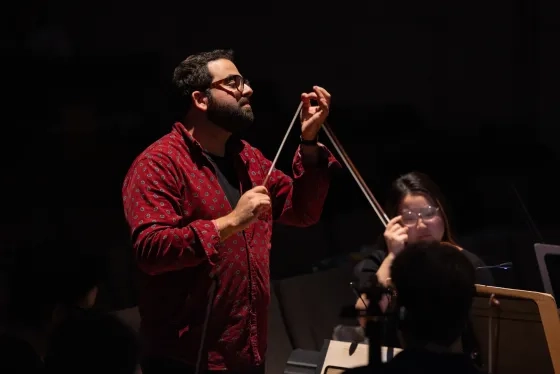
Lohraseb is an Opus 3 Artist who, as part of SFCM's Global Creative Alliance, has spent weeks at SFCM rehearsing with students for the Conservatory's Nov. 19 and 20th performances of Giacomo Puccini's Suor Angelica. His familiarity with opera extends to being in the spotlight as a performer: Lohraseb made appearances on Rosie O'Donnell's television show and Live with Regis and Kathie Lee as, in his words, "this little boy who just loves to sing and loves opera." Along with his singing, he was studying piano and taking his first steps towards composition, and by his teenage years, was studying with renowned Mozart scholar Robert Levin.
Levin's spirit continues to animate Lohraseb's work. "He can go in front of people and ask them for themes from the 18th and 19th centuries and then do a whole improvisation. And that keeps this music alive, keeps it living, keeps it exciting. So I learned from him that you do the research and the work to try and get to the bottom of what was there, but then the other part of it, which a lot of people forget, is answering the question of what to do with that knowledge. For me, just replicating something to be embalmed on a shelf is not the way to do it."
To that end, though, Lohraseb says that while it's his first time conducting Suor Angelica, it's a deeply felt piece for him. "At the end of our second rehearsal, I got to the end of the piece, and recapping what was happening, I got teary-eyed—and I could see so many students in the orchestra with the same expression. This is such a moving piece."
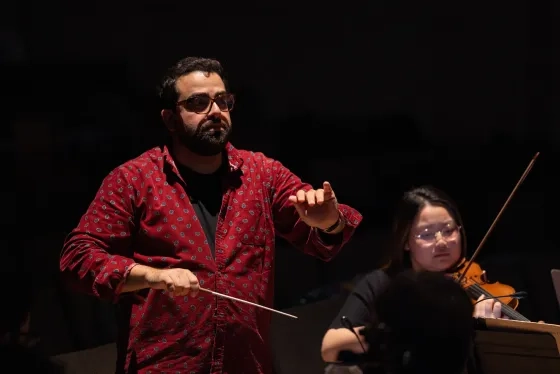
"Puccini was like every other composer in only writing down information that would not be obvious to a well-trained musician of their time," Lohraseb continues. "This is part of the debate around performing Mozart with the ornamentations musicians of their time would have used. Puccini knew that performers would be improvising, but he didn't know that in 2026 people would respect him so much that they wouldn't take those same liberties. So to really live the piece, you have to understand that fluidity and flexibility of it: Even for a well-trained, great symphonic orchestra, when you try to do that in concert, it becomes a whole different language."
Unfortunately, Lohraseb was not admitted to Harvard to continue studying with Levin. "That was a very hard moment for me as a 17-year-old," he says. But, after completing his undergrad studies, he was accepted as a conducting fellow at Yale, where he attributes one of his big breaks to a moment of inspired, targeted showmanship. In Lohraseb's first year of post-grad, James Conlon, then Music Director of Los Angeles Opera, visited Yale. "I knew that I had one shot to get his attention," Lohraseb recalls. "They threw him some sort of pizza party after one of the rehearsals, and I just went to the piano and I just started playing cabalettas in D-flat that Verdi wrote, thinking, you know, 'I'm not just gonna do La donna è mobile;' something niche might catch him.' And it did! He said, 'So you like Verdi, huh?' and invited me to observe him at LA Opera and then that summer at Ravinia."
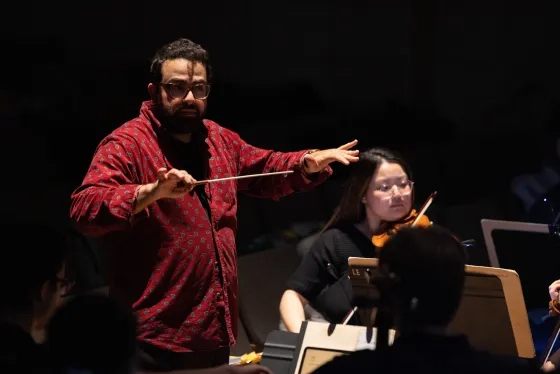
After some additional studies, Lohsreb accepted Conlon's offer to move to LA to work as his assistant. "We talked about being from New York, and how Los Angeles was always a place of dreams coming true: Hollywood, perfect weather," Lohraseb laughs. "But in a way it was for me: I got my first paying job, got married, had children—all stemming from those experiences that started in LA."
Though he doesn't maintain a private teaching studio, when in educational settings like at SFCM, Lohraseb says he "carries all the teachers in my life with me, everywhere I go. My first serious piano teacher, Findlay Cockrell, had this genius of, when he played a piece, you wanted to play it yourself. He taught me the idea of always searching for what lies behind the notes and making your own interpretation of the piece. Maybe holding a note down that isn't indicated that way brings out a new texture; so we look at the material and try to figure out what we can say with it, how we can make it personal."
For student conductors like SFCM's Grace Wahlen and Jason Gluck, Lohraseb has a piece of advice that hearkens back to his pizza-party piano moment with James Conlon. "You never know what, out of all the work you've done, will end up being the thing that gives you a chance for success. I was fortunate enough that when I was younger—because all the minutiae of life will compound as you get older—I studied a lot because I loved it, and I wanted to know. My big U.S. break was conducting Tosca at LA Opera. I was in Philadelphia conducting, and LA called and said, 'You wanna do this?' And the only way I felt great doing that was knowing that piece since I was five: I felt incredibly comfortable in a high-pressure situation because I already knew what I wanted to say with it."
Learn more about studying Voice or Conducting at SFCM.