Meet the Muselar, the Newest Addition to SFCM's Historical Instrument Collection
SFCM's historic instrument collection is available to students from all departments, from Voice to Technology and Applied Composition, who have created custom samples from them.

SFCM's Historical Performance Department Chair Corey Jamason.
The San Francisco Conservatory of Music has a new (old) member of the family: A 17th-century muselar, a kind of harpsichord that will allow students new insight into decades of Renaissance music.
Harpsichords are defined by having their strings plucked by a quill, rather than hammered by a striker like a piano. (SFCM's muselar's quills are from the Corvid family, which includes crows and ravens.) Confusingly, muselars are often also referred to as "virginals:" The exact origin of that term is unclear, and made even more unclear by the fact that, during the Elizabethan and Jacobean periods, a wide range of stringed keyboards were all referred to as "virginals." (Fun trivia fact: The term is also memorialized in one of William Shakespeare's sonnets.)
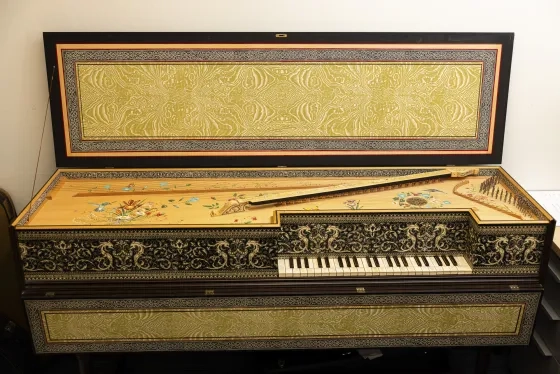
SFCM's muselar.
This new muselar is built in the 17th-century Flemish style. Antwerp was a major center for building keyboards from the mid-16th-to-18th centuries, and as other countries began building harpsichords, French instrument builders were noted for their devotion to the original style. Its border paper's designs are drawn from engraver Balthasar Sylvius, while the instrument's rosette (the carved embellishment covering its top soundhole) is a bit of a red herring: The initials WH refer not to its actual builder, but another 20th-century builder, William Hyman, whose instruments are highly prized worldwide.
"This muselar is literally the perfect instrument to play an incredibly important body of keyboard repertoire," Historical Performance (HP) Department Chair Corey Jamason says, adding that he considers the repertoire written by British composers in the 16th and early 17th century among the most important early solo keyboard music.
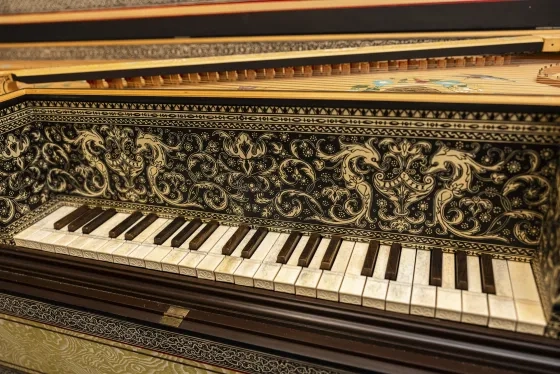
The Flemish paper decoration on SFCM's muselar.
"Going back to the late 14th century, composers were certainly writing keyboard music, but they tended to be transcriptions of dances or vocal music," Jamason explains. "Composers in Elizabethan England wrote some of the first great keyboard music written as independent keyboard music."
"This instrument will allow our keyboard students to explore late Renaissance music, paralleling Professor Elisabeth Reed's viola da gamba class, which explores viol concert music from the same period, as well as the SFCM Chorus, which often explores Renaissance repertoire as well," Jamason added.
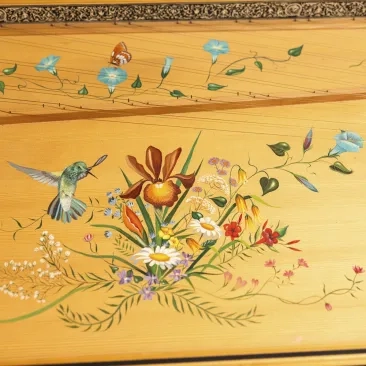
Close-up of painted details on SFCM's muselar.
SFCM is rare in that it allows its entire student body access to its collection of historical instruments. "This semester we have a class called harpsichord for pianists," Jamason says, and there are usually 10 to 15 piano majors in that class, and they get to experience all of our harpsichords."
Conservatory-wide access to the historical collection is something Jamason stresses as a key differentiator at SFCM. "Our historical keyboard collection at SFCM offers students an invitation to experiment," he says. "Piano majors and collaborative pianists can explore chamber music on the appropriate instruments. We currently have a collaborative pianist working now on a project using our Mozart-era fortepiano. We've had composition students play these instruments and get excited about writing new music for them, and a year or two ago I had a student in the Technology and Applied Composition Department sampling sounds on the harpsichord to use in a pop song. The instruments are all here for our student's use, accessibility is total. It is incredibly exciting to witness our students find their voice with these instruments."
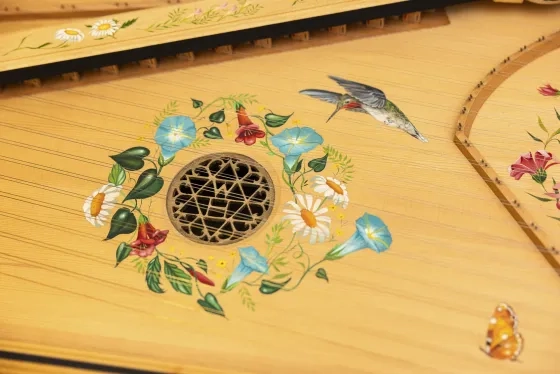
Close-up of the soundhole decoration on SFCM's muselar.
This newly donated keyboard has a special personal resonance for Jamason as well. "This was built by my harpsichord professor at Yale, Richard Rephann, who for many years was the director of the Yale Collection of Musical Instruments. As a person and as a teacher he was a hugely impactful person in my life. I played this instrument frequently in his studio; it was acquired some years ago by his friend the Rev. Richard Fabian, who moved it to the Bay Area and then donated it to us in December 2025."
"Having it here to give SFCM musicians the opportunity that I had to play this magnificent instrument when I was a student is very meaningful," Jamason says. "And I like to think Richard Rephann would be very pleased to know it's here with us. Our students will gain so much from playing it. "
Learn more about Historical Performance or Technology and Applied Composition at SFCM.