How Katherine Siochi Is Making Sure Harpists Across the Country Are Prepared to Audition
Siochi has compiled a nationwide list of orchestral and symphonic audition info dating back to the early 1990s.

One title you won't see listed after the rest of Katherine Siochi's credentials (Principal Harp, San Francisco Symphony, gold medalist of the 2016 USA International Harp Competition) is "data enthusiast."
But Siochi's biggest non-musical project at the moment is a statistician's dream: a nationwide survey of harp repertoire and excerpts from orchestra auditions over the last 35 years, organized into a handy resource for teachers and students.
Siochi remembers nearing graduation and being fully in the recital-audition-gig cycle of a busy student musician, which required budgeting her practice time efficiently. "A typical audition will have maybe two to three solo pieces that are required and then anywhere from 15 to 25 orchestra excerpts," she explains. "Those excerpts vary quite a bit in length: Some are as short as maybe 30 seconds long, and others are basically the whole work. Even after I had my first job, I kept taking auditions and continued to discover new excerpts that I had never studied before."
Much of the information about orchestral audition rep for any instrument is passed along informally, but Siochi says, "The idea behind this project was, 'Well, where's the data to actually back up those statements?' I had never seen anyone approach this with such detailed, firm statistics. My goal is for it to be a resource that allows students and professionals to actually learn, statistically, the most frequently appearing excerpts."
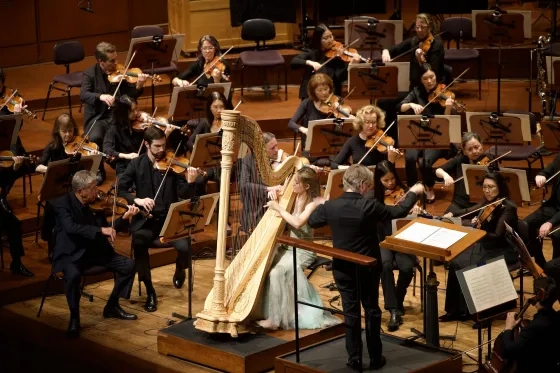
Katherine Siochi performs with the San Francisco Symphony.
Siochi started the list by drawing from auditions she'd taken and added a substantial number from simply Googling, which she says turned up "the whole gamut from smaller budget orchestras to the Big Five or Seven." But as she shared the project, she says, "it became sort of a community effort where other harpists were giving me their lists, which was super helpful. So essentially, I just took all the information on these lists and organized it to show how often each excerpt appears, and what percentage it represents overall."
The project turned out to be a valuable lesson as far as the shortcomings of digital archiving goes as well. "I posted on my Instagram and Facebook at one point, and that was when a few other people who've been playing in orchestras much longer than me gave me their lists," Siochi says. "That's how I got some from the 1990s: People literally scanned paper copies and sent them to me, because they'd be impossible to find online."
(One really nitty-gritty detail Siochi's research includes: The ensemble's official tuning pitch: Because harps have an involved and extensive tuning process, harpists must tune early and account for the fact that the instrument will then subsequently flatten before the music starts. So, for the San Francisco Symphony (SFS), the "official harp pitch" is listed as A=442 hz, one cycle higher than the rest of the orchestra's standard tuning pitch of A=441 hz. "There's a joke," Siochi wryly notes: "Harpists spend 50 percent of their time tuning and the other 50 percent playing out of tune.")
Siochi's work affords a long view of the harp's use in professional orchestral settings. "When you kind of zoom out over the 30 years, there are pieces that are more common long-term," Siochi says. "What I noticed in the last 10 years when I was taking auditions was that the orchestras would kind of copy each other. So you'd see a lot of the same excerpts in periods of two or three years, but longer term, they'd be less common. Some kind of surprised me, at least as an excerpt, like Debussy's La Mer. That's relatively high up on the list, but I had always had this perception that it was a 'deep cut'-type thing. Same with Stravinsky's Symphony in Three Movements: I always thought 'Oh, that's a more unusual excerpt,' but when you look at the whole data, it's very common."
Pedagogically, Siochi's use case for the project is asking an incoming student which of the works they've already studied, and prioritizing pieces that appear more commonly as audition requirements. "So during the course of their degree or degrees, then they've really thoroughly covered the most frequently appearing ones but are also aware of the oddball ones that only appear once in this entire set."
Like pianists or tubists, harpists are in an extremely competitive field by virtue of their instrument choice. "Harpists in orchestral and symphonic jobs are there for 30 or 40 years: Those jobs, especially in the bigger cities, just don't open up very frequently. So the next phase of this is looking at which excerpts appear in preliminary rounds, because that's very often the hardest: You might start with 50 or 60 harpists, so you really have to be super-solid and stand out to make the cut."
Asked for her favorite piece on the list, Siochi names Max Bruch's "Scottish Fantasy, Op. 46" from 1880. "It's a violin concerto, but it's almost a duet between harp and violin. The fourth movement of that appears three times on this list, but it was only part of one audition I ever took. And that's an example of one that's important to know in advance because it's so exposed."
The project doesn't really have an end date: Aside from refining the list to address preliminary round excerpts, Siochi would like to gather this data for opera and ballet auditions as well. And she plans to update the list as the repertoire evolves: "I just get really nerdy about this stuff," she grins.
Learn more about studying harp at SFCM.