An Award-Winning Composer Returns to SFCM to Premiere a Work Years in the Making
Highsmith Award-winning composer Pierre Fontaine graduated in 2023 after studying with David Conte.

Pierre Fontaine.
Some SFCM alumni have to travel further to visit, but the Conservatory is always thrilled to welcome—and celebrate—their return.
Such is the case for French native Pierre Fontaine, a 2023 Composition grad who returned to SFCM in April to premiere his Highsmith Award-winning composition Ancient Dances of Modern Times (or Suite de Danses No.1) with the SFCM Orchestra.
The Highsmith award is endowed by James (Jim) Milton Highsmith, an English teacher and department chair at Lone Mountain College with a lifelong passion for drama, music, and literature. His interest in the Conservatory stemmed not only from his love of music, but also from his friendship with former Conservatory President Milton Salkind.
"The Highsmith Orchestra Composition Prize is in many ways the most important opportunity for our student composers," Composition Department Chair David Conte says. "It represents the mastery of a wide range of specialized knowledge of all the instruments, of orchestration, and of the control of the formal unfolding of complex musical ideas. Historically, many of our most gifted composers have won this prize, and it has enabled them to move forward into the professional world of commissions and college and university positions."
Fontaine recalls that he'd acquired three "pre-professional" degrees in France's educational system before casting about internationally for a teacher.
"I looked up teachers around the world, and specifically in the English-speaking countries, and I found David Conte," he says. "Before reading his bio, the first thing I did with anyone was listen to their music, and David's music is why I wanted to study with him. It's so technically sound; it makes sense to my ear; and its smart logic is the narrative behind it. So after that it was, 'Okay, so now let's see who he is,' and then I found out that he has a connection to France with Nadia Boulanger and studied with her, and for me it felt like, 'Maybe it's not destiny, exactly, but I should try and see what he can teach me."
"Pierre Fontaine was an outstanding student during his time at SFCM, winning prizes in the Biennial Art Song and Choral Composition Competitions and the Pankonin Art Song Award," Conte recalls. "He's the only French composition student we've had at the Conservatory, and because France represents the longest unbroken composition pedagogical tradition in the West, he arrived at SFCM with very strong preparation."
"I like to say I had to go about 9,000 kilometers from my own country to actually discover the music from there. David taught me about [Maurice] Ravel, [Claude] Debussy, and especially a lot about how Nadia knew them. This was crazy to me! I did all this education in France and I listened to [Ravel's] Daphnis et Chloé for the first time in San Francisco. It was a revelation to me, this piece, and now it's been five or six years and I listen to it every single day."
Aside from becoming enamored of other composers like Aaron Copland, Emmanuel Chabrier, Jacques Ibert and R. Vaughan Williams, Fontaine also remembers a variety of other SFCM classes, classmates, and teachers that contributed to his compositional voice.
After taking a Baroque dance class at SFCM, Fontaine discovered "discrepancies" in works named for certain dances—Ravel's Menuet Antique or Debussy's Passepied, for example—in which the music didn't actually reflect the actual dances. He recalls, "Professor Corey Jamason referred me to some 18th-century books by two choreographers named Feuillet and Pécour, who invented melodies and wrote them out next to the steps for the actual dances," which planted the seed for his Highsmith composition, Ancient Dances of Modern Times.
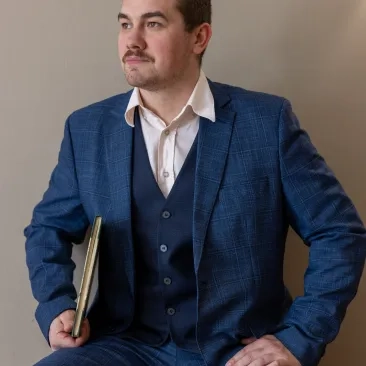
Pierre Fontaine.
"Then, I borrowed different forms and structures that could apply to these dances, and I came up with my first suite, which is actually six movements in total," Fontaine says. "I really like the idea of hiding a motif continuing through different movements, and it was a technical challenge to vary that melody with the different meters and tempos of these dances. That was probably the best time I ever had composing something."
Fontaine's piece also contains some nods to his ancestral homeland in Corréze, France. While the three movements are named for dances—branle, passepied, rigaudon—the third movement, titled "Occitan Rigaudon," is a nod to Occitan, a dialect spoken in and around Corréze.
"I've been going there since I was born," he says. "I do a lot of hikes, go to the woods. Corréze is a section of the French diagonale du vide ("diagonal void") because there's nothing there, very few people. But I'll go and have the best time ever. There's a lot of medieval and peasant history there, and with that comes folk music and dances, so I wanted to pay tribute to that."
Paris, San Francisco, and a diagonal void: a musical journey that shows off what makes SFCM so special.
Learn more about studying Composition at SFCM.