Police Drummer Stewart Copeland on How He Came to SFCM for a Side-by-Side with Students

Stewart Copeland with SFCM students at SFJAZZ.
After introducing the rest of the band and SFCM orchestra onstage with him at SFJAZZ, Stewart Copeland joked, "Those are the real musicians." Gesturing at himself and the SFCM percussionists, he added, "We hit stuff."
It's a bit of an oversimplification, but it's part of Copeland's larger-than-life personality, which animated his subtly virtuosic drumming with The Police. Following that band, Copeland expanded his musicality with film scores and a variety of left-field collaborations, a career that recently touched down at SFCM.
Copeland was in San Francisco to perform Police Deranged for Orchestra (PDO), drastically reworked arrangements of the hits from his famed band. But through his friendship with SFCM Music Director Edwin Outwater, Copeland brought a small orchestra of 29 SFCM students onto the SFJAZZ stage, where they played two sold-out shows as part of the Conservatory's annual donor gala, which this year raised over $500,000 for scholarships.
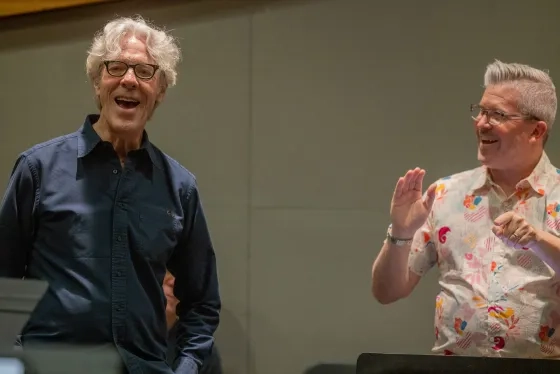
Stewart Copeland and Edwin Outwater
"Edwin was the conductor who, you could say, created PDO," Copeland says. "He was the first conductor on board and he really did a lot of homework, ironing out all kinds of mistakes I made in the score and such. Edwin came in and kind of built the show and he's been my favorite conductor ever since."
"It was such a joy to have Stewart and his Police Deranged musicians at SFCM," Outwater says. "He was incredibly generous with our students, and gave them a masterclass in groove throughout the week. Stewart's energy and rhythmic vitality transcends genre, and the feeling of playing along with one of the greatest drummers in the world will stay with our students throughout their lives as they create their own rhythms in music and life."
Copeland also made time for a visit to the SFCM Percussion department, where students read through his composition The Bells, a tricky 10-minute piece with overlapping rhythms inspired by gamelan music.
"The ensemble had a great experience hearing from Stewart and his take on chamber music," Percussion Department Chair Jacob Nissly says. "Playing in a rock trio, jazz quartet, string quartet, or percussion ensemble all require the same skill: listening. He focused on that and had some great advice for our students on how to catch one another rhythmically without having to rely on a conductor. It was a great experience for everyone involved."
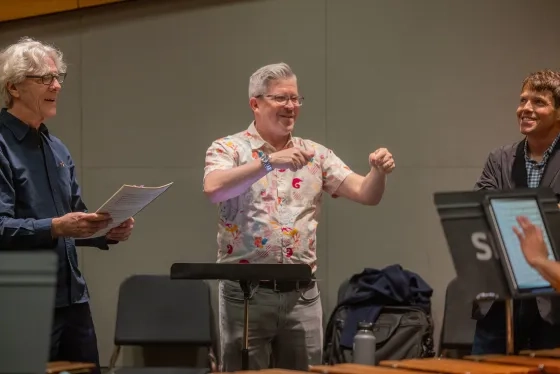
Stewart Copeland, Edwin Outwater, and Jacob Nissly.
Copeland cites his work on Francis Ford Coppola's 1983 film Rumble Fish as an inflection point in his arranging and larger-scale composition. "I was recording it all myself, playing all the instruments: Guitars, drums, a bit of piano, mallet instruments and weird percussion, and tape loops of found sounds," he recalls.
"But one day, Francis says, 'This is all sounding great, but we need some more. We need some emotion. We need strings, okay?'" Copeland continues. "And immediately, I was afraid he would call him some hack to put schmaltz all over my stuff. So I said, 'Yes, Francis, I was just about to suggest that.' I called up the contractor and told him, 'The director wants strings,' and he said, 'Cool, how many?'"
"I said, 'I don't know! Strings, plural. Let's go with 'many.'" Copeland quips. "About 16 folks turned up. I had actually studied music in college, but had not seen a single sheet of music paper during my entire career up until that point. Because in rock and roll, we don't use charts. Have you heard this one? 'How do you get a guitarist to turn down? Put sheet music in front of him.'"
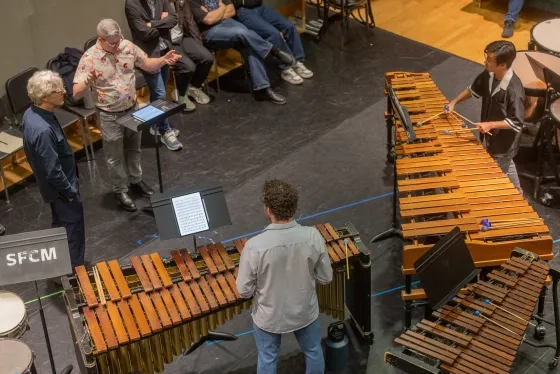
Stewart Copeland's percussion workshop at SFCM.
Comparing the experience to working with a guitarist with whom, "you just throw ideas back and forth with," Copeland remembers one notable moment with the first violinist when he attempted to guide the strings verbally. "She puts up her hand and says, 'Maestro, do you want us to play what's on the chart here or whatever the hell you're talking about?'" he laughs. "Thus began my journey with the orchestra."
Via Rumble Fish, Copeland was then tapped by Michael Smuin, then the Co-Artistic Director of the San Francisco Ballet, for an original ballet, which turned out to be an adaptation of King Lear. "It was a disaster, pretty much," Copeland laughs. "The San Francisco Chronicle tore me to shreds. I've still got that review. One day I'd like to meet that guy and shake his hand, because the worst part of it was that most of it was true."
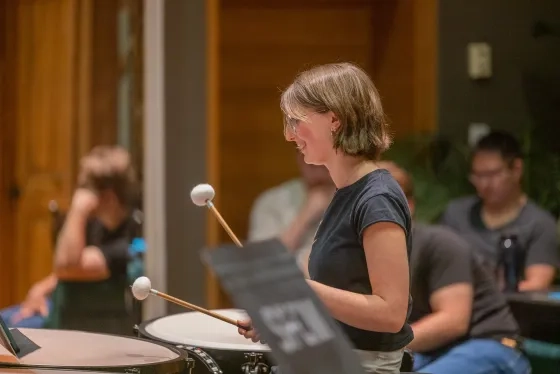
Percussion student Nava Gold plays in Stewart Copeland's Percussion department workshop.
But, he continues, "There were four bars that did work, and that four bars was enough to keep going, thinking, 'I'm going to write another one of these, and maybe I'll get eight bars this time.' Even though it was kind of a disaster, there were parts of it that did work, and I'd gotten the bug. So my first big orchestral experience was right here in San Francisco."
Working with Outwater and the SFCM Orchestra went considerably smoother: "A rock band takes two months to get a show together, there's a lot of arguing and negotiation and collaboration. Orchs, they read it off the page: I meet them for the first time in the afternoon, and it's 'How ya doing?' How ya doing?' Two and a half hours later we'll be ready for showtime, doors open at 7."
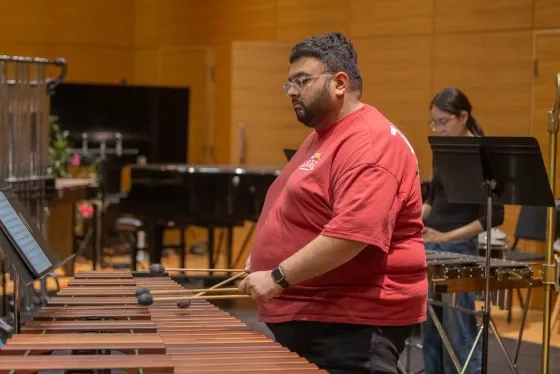
Percussion students Ahmad Yousefi and Isabelle Harmenta in Stewart Copeland's SFCM workshop.
Copeland also has extramusical advice for anyone collaborating with an orchestra: "I schmooze. It makes a difference! I've got my pickup lines: I'll go up to the oboe and say, 'So tell me about your reeds,' in a loud voice, and all the other woodwinds go, 'No!'"
"Also, I always chat up the violi," he continues. "Most rock musicians are intimidated by orchs and vice-versa. I was when I first started: It's a little intimidating because these players are on a very different continent of music. So I found that if I go amongst them and hang, they loosen up, they play better, and the energy that comes from the bandstand to the audience is just better."
Learn more about studying Percussion at SFCM or the SFCM Orchestra.