'We Have to Feed Artistry Wherever It Grows:' Voice Chair Richard Cox Talks Teaching
Cox is a firm believer in cross-training for vocalists and brings that enthusiasm to SFCM's recently expanded multi-genre Voice curriculum.

Richard Cox.
For someone who played Captain Ahab, one of the most famously obsessed characters in all of literature, Richard Cox is a pretty laid-back guy.
As announced in 2024, the renowned tenor joins SFCM to lead an innovative curricular expansion of the Voice/Opera Studies program as Executive Chair: All undergraduate voice students will continue to focus on the highest standards of professional training, while repertoire and technique will openly embrace opera, musical theater, and contemporary music. Cox, who recently wrapped up his first summer teaching at the prestigious Merola Opera Program, sat down with SFCM to answer questions about his journey back to teaching after a performance career, his teaching style, and where voice training is today.
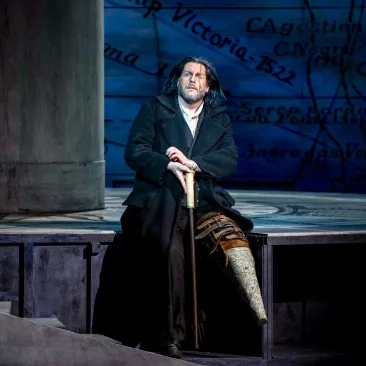
Richard Cox as Captain Ahab in 'Moby Dick.'
SFCM: This was your first summer teaching at Merola, which has a long history with SFCM. How was it?
Richard Cox: What's so wonderful about it is that we're really getting the opportunity to work with singers at the level of "not a student but not quite a professional." It's an interesting age for singers, because they've cleared most of the fundamental hoops of the art, and that's why I find it important to stress to them that they're where they are because they do what they do well, so there's no need to throw out everything that they've learned. At this point, you can still really make a difference in what they're doing and what they're willing to try.
What do you look for in a prospective student?
Well, that same kind of openness, basically. It becomes a question of, "Do they have a teachable spirit?" Are they open to being taught, or are they just looking for someone to say "You're doing great!" and not much else. Sometimes that is our job, though [laughs].
My first degree was in music education, and one of the things I love about working with this next generation of singers is that we're now in a place where it's not the norm to just be mean and browbeat the next generation of singers. That kind of instruction was somewhat still around in my generation and even a bit with the one that immediately followed me.
How do you approach non-private teaching formats, like masterclasses?
I have to be honest with you, I don't always enjoy one-off masterclasses, unless I can get one-on-one time with the performers beforehand.
You know, with masterclasses you have to make these split-second decisions, like "What can I go after that isn't going to embarrass this person and cause them to close themselves off?" A singer will get up there to sing for a public audience they most often won't know, and they don't know anything about me, which makes them more nervous. So to relax them, you say, for example, something harmless like, "Spin the breath" and have them sing again and they're going to be 20 times better because they're not as nervous.
Even in a group situation, I like having the opportunity to work with a student and begin to develop a shared instructional language.
Could you elaborate on what you mean by that?
I try to build instructional language with each individual student, because it's different for every person. That's an attitude that I do feel is a little more unique to this time: We're teaching individuals, not a prescribed one-size-fits-all technique.
When I'm beginning to work with a student, my job is to listen. Tell me your story, tell me a little bit about you. Who's your favorite singer? What's your favorite piece to sing? What's drawn me to SFCM is the move to include multi-genre curriculum for our singers: I don't want a student to just give me the answer they think I'm looking for. I'd rather someone be honest and say, "I love Lady Gaga," instead of "I love Mozart"—if that's genuinely the case. Then I can be like, "Me too! What do you think is so incredible about her? What does she do that you identify with?"
In my teaching, we ground things in classical technique, but with the non-technical side, the artistry, we have to feed that from where it has grown. My philosophy is, the only reason we study technique at all is to help support our expressivity. The better someone sings, the more chances they have that people will want to hear what they have to say, beyond just the idea of technical perfection.
What else goes into developing that personal language?
It's important for me to make the teaching relationship a dialogue. One of the big things I say is, "It's your voice, so it's your choice." I can say to you, "I think this would help you in this way," but if you're married to that idea, then that's your choice to make.
Because I made my own choices, and I was just as stubborn when I dug into things. For example, I did Jake Heggie's Moby Dick, and I remember asking the conductor, "Look, I make a choice here on this page, and I cannot keep myself from doing it, but it costs me every single time, so I need the orchestra to cover me. I've done it every time, I always push it too far because of the emotion, and I just can't seem to give it up."
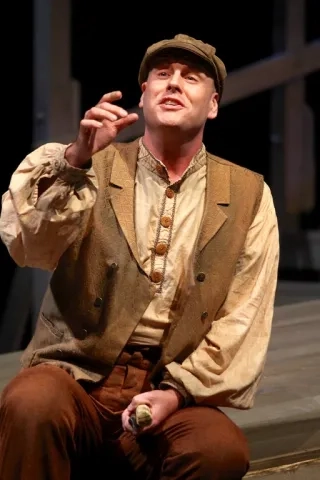
Richard Cox in as Laca in 'Jenůfa.'
What are some of the challenges unique to teaching singers?
A lot of us start so much later than instrumentalists—I didn't start, really, until I was 19, and I had my first piano lesson at 20. So sometimes singers feel they're behind and need to "catch up," and you have to slow them down and let it be okay that something's taking a while to do right.
And as singers, our instrument is constantly changing. One of the problems with that is that we get into a results-oriented mindset about our voices instead of a process-based one. I think that's the biggest gift you can give to a young singer: to just get them to focus on the process of any given day. You emphasize that this is a lifelong path so they're not discouraged when they're not hitting certain milestones, like I was when it was 1993 and I was writing in my journal, "I hit an F# today." [laughs]
For me, it felt like most days I wrestled my voice to the ground for what it had to do that night. It was, "You're going to do this" by sheer will, because I didn't have my vocal chops naturally, I had to fight for everything. Luckily, it's made me a better teacher because I can recognize that now and protect students from the drawbacks to that attitude.
Do you still feel like you have to do that with your voice?
I don't sing as much outside of my studio anymore, but I do vocalize before I begin teaching for the day. Personally, I find the singer/performer's ego and teacher's ego are difficult to combine. For me to achieve what I felt was my 80 percent, I had to be wholly focused on and protect each and every performance. I found other colleagues didn't have to be quite so careful, but I couldn't. I almost had blinders on during my career: I was so focused on what I had to do to live up to my own standards..
When I'm teaching, it's about the person in front of me. It has nothing to do with me. So even though I always loved teaching, I resisted coming back to it for years, because teaching and performing are two separate ways of thinking, and I just knew myself well enough to know they weren't easily compatible for me.
When did that mindset change occur for you?
There was one specific moment I remember: A Sunday afternoon concert doing Siegfried in the Ring Cycle, just Act Three. At the reception afterwards, someone said to me, "Oh, a new Siegfried is born!" and I was like, "Really? Actually, now I think I know where my line is." [laughs] I could have sung that role, but I would have needed two or three days off between performances, because I had to push myself so hard. I was proud of that performance, but I knew that it wouldn't be sustainable without a very specific set of circumstances in place.
That Tuesday I gave a masterclass in upstate New York, and I'll never forget the train ride back into the city that night. I remember sitting there thinking, "I enjoyed the two hours I spent working with those students more than I enjoyed Sunday's concert." It was just an immediate moment of clarity, like I suddenly knew teaching was what I was supposed to be doing.
Learn more about Voice/Opera Studies at SFCM.