SFCM's Big Band Prepares for Its Monterey Jazz Festival Debut in September
The Monterey Jazz Festival is the longest continuously-running jazz festival in the world.

The Roots, Jazz, and American Music Big Band.
The Roots, Jazz, and American Music (RJAM) Department's Big Band is headed to a big stage.
Namely, the Monterey Jazz Festival, founded by San Francisco DJ Jimmy Lyons and famed San Francisco Chronicle jazz critic Ralph Gleason in 1958. It's the first time the RJAM Big Band, under the direction of RJAM Executive Director (and SFCM's Associate Dean of Community Development) Jason Hainsworth, has made the trip to Monterey for the occasion. The ensemble will be playing the festival's Tim Jackson Garden Stage on Saturday, September 26 at 1:30 p.m. (Tickets available here.)
"The students are really excited about doing it," Hainsworth says, noting that because of SFCM's close relationship with SFJAZZ, where RJAM students frequently perform, the musicians "all have experience in this professional world, like, 'This is what you need to do' if you're hired to perform at one of these festivals."
The Big Band is a relatively new addition to SFCM's ensemble offerings, and it's a valuable learning experience, not only for the tricky musical challenges posed by big band arrangements (nearly always more complicated than small-group charts), but for how big band repertoire sits in jazz history: "We're always trying to work on building our students' repertoire so that when they're out of school, they can recognize pieces and be like, 'Oh yeah, I recognize this, I've played through this,'" Hainsworth says.
One piece the group will be playing in particular, "My Centennial," has a close association with the famed Manhattan jazz club The Village Vanguard's big band (known as the Thad Jones-Mel Lewis Orchestra for 13 years). "I wanted to find something that would really, really challenge the band as a whole," Hainsworth grins. "That's probably one of the more challenging pieces that the Jones-Lewis band in New York ever played: It's a lot of complicated rhythms, overlapping melodic lines, and a pretty challenging range for the brass. So I thought our students would get a kick out of playing it, and they all did great."
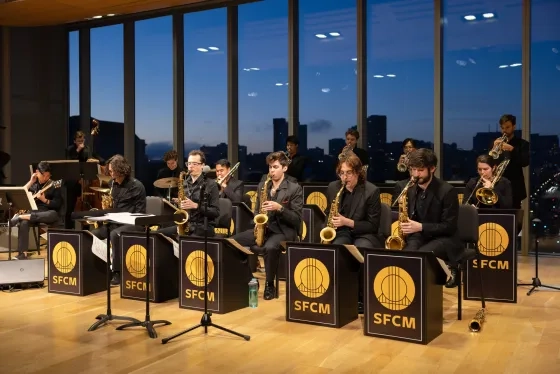
SFCM's Roots, Jazz, and American Music Big Band.
As jazz spread from its roots in New Orleans in the first third of the 20th century, big band swing became hugely popular dance music across the U.S. And it may have local roots: Some credit San Francisco drummer Art Hickman and his arranger Ferde Grofé (who orchestrated George Gershwin's Rhapsody in Blue for its 1924 premiere) with leading one of the nation's first big bands and codifying elements of the arranging traditions of the form. However, the Great Depression made it all-but financially impossible to keep ensembles of 20 or more musicians on the road, and working jazz bands slimmed down to single-digit membership.
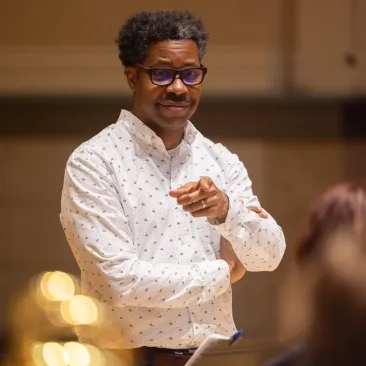
Jason Hainsworth.
The same economic impracticalities affect the big band tradition today. "There are regional big bands that have a pretty large following but don't tour," Hainsworth says. "They're considered repertory jazz orchestras; they might play nine or 10 times per year." But musicians keep the ensemble format alive, not only for the sheer thrill of performing with a large ensemble, but for the unique challenges the music offers. "One of those aspects we want to instill in our students is that there's a certain level of musicianship needed as part of a larger section or in a full band that you don't get playing in a small combo," Hainsworth continues. "If you're the only saxophone in a quartet, you don't really learn how to blend your sound in the same way. Because of that, there are a lot of what we call rehearsal bands—and there are three or four in the Bay Area—made up of musicians who get together to sight-read charts just to keep themselves honest."
RJAM Assistant Director Amelie-Anna Hinman points out another reason why it's important to musicians to be familiar with a big band setting. "When artists come to any given city, they usually don't bring their own big band," she says, "so they'll ask their agent or whoever they know in the city, 'Hey, can you get a band together for me?'"
"So if you're known—for saxophone players, for example, to be able double on clarinet or flute—or for having big band experience, that is yet another gig that you add to your portfolio," she continues. "I feel like jazz musicians these days are really portfolio musicians because they need to be able to have this wide range of knowledge to get as much work as they want."
Learn more about studying Roots, Jazz, and American Music at SFCM, or get tickets to the RJAM Big Band's Saturday, September 26 performance at Monterey Jazz.