'Eugene Onegin' Composer, an SFCM Grad, Talks His 'Triumphant' SF Ballet Premiere
Ilya Demutsky graduated from SFCM in 2009, and not even a decade later had his work premiere a few blocks from SFCM's 50 Oak Street campus.

'Eugene Onegin' at the San Francisco Ballet.
2009 Composition graduate Ilya Demutsky (who studied with department Chair David Conte) has plenty to celebrate back home in his native Russia this week. His ballet, an adaptation of the Russian novel Eugene Onegin by Alexander Pushkin, premiered at the San Francisco Ballet (SFB) on January 23 and garnered rave reviews from both The San Francisco Chronicle and San Francisco Classical Voice, among others.
The Chronicle called the work "ambitious—and worth taking seriously," describing Demutsky's work as "impressive." Calling the ballet "triumphant," SFCV called Demutsky's score "wonderfully eclectic," while SFB Music Director and Principal Conductor Martin West wrote that "Demutsky is still younger than Prokofiev was when he wrote Romeo and Juliet, and only fractionally older than Tchaikovsky when he wrote Swan Lake. Ilya is much too humble to compare himself with these composers: luckily for us, his music speaks for itself."
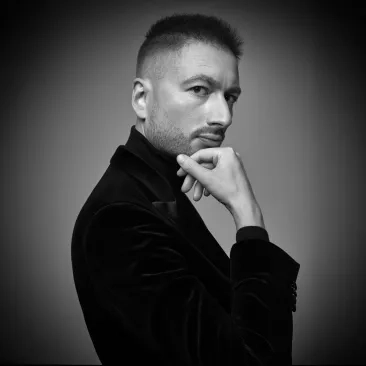
Ilya Demutsky.
The SFCM Newsroom caught up with Demutsky after the ballet's run to learn more.
What brought you to SFCM to study composition?
While I was studying at the Saint Petersburg Conservatory, I came across a small announcement about the Fulbright scholarship, which made it possible to pursue graduate studies in the United States. That opportunity changed everything. Through Fulbright I arrived at the San Francisco Conservatory of Music, where I began my master's in composition.
Until that moment my focus had largely been on choral music and conducting. In San Francisco I shifted more decisively toward instrumental and orchestral writing, which later became crucial for my work in theatre and ballet. Those years were intense and demanding, but they gave me confidence in my artistic direction and a sense that my musical voice could develop freely.
How did the work come to be staged at SF Ballet?
Eugene Onegin was commissioned by San Francisco Ballet in co-production with the Joffrey Ballet of Chicago. I had previously worked with San Francisco Ballet, so there was already an artistic relationship and mutual trust. The project grew out of ongoing collaborations between the creative team and these companies. Once the idea of adapting Onegin took shape and the team was assembled, San Francisco Ballet became a natural home for the work.
It is also my sixth ballet with Yuri Possokhov, who serves as choreographer-in-residence at San Francisco Ballet. From our very first project we developed a strong creative partnership, which over the years has grown into both a solid artistic tandem and a deep friendship. That continuity of collaboration naturally contributed to the work finding its place on this stage.
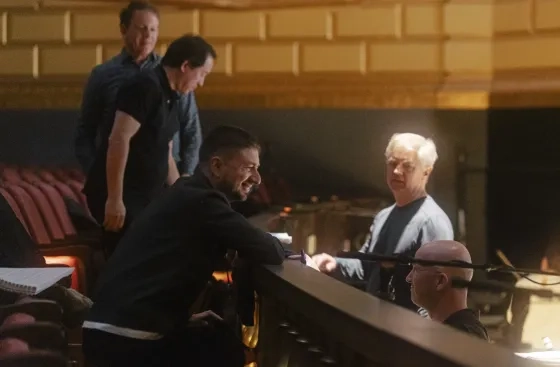
Ilya Demutsky (left) confers with SF Ballet Music Director Martin West.
How did studying with David Conte help refine your voice as a composer?
David Conte played an important role not by pushing me toward a specific aesthetic, but by strengthening my trust in my own musical identity. I remember him telling me not to be afraid of the "Russianness" in my music, that it was part of what made my voice unique. That idea stayed with me.
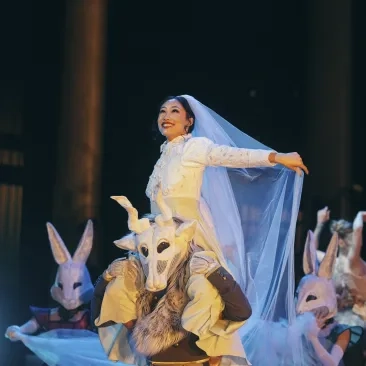
'Eugene Onegin' at the San Francisco Ballet.
At the Conservatory I worked very intensively on craft: form, orchestration, clarity of musical thought. For me, internal logic is fundamental: A piece isn't finished until its development feels inevitable. That discipline, combined with the freedom to remain myself stylistically, helped refine my voice in a very concrete way.
Equally valuable was the opportunity to participate in interdisciplinary collaborations within the Conservatory. Writing projects specifically for viola and other string students, as well as the choral and art song writing competitions, allowed me to work directly with performers. Writing for real musicians, hearing pieces immediately brought to life, and adjusting details in dialogue with them was an essential part of my growth. It strengthened not only my technical skills, but also my understanding of how music functions in practice.
What drew you to adapting Eugene Onegin?
The emotional and psychological depth of the story. At its core, Onegin is about missed chances, pride, time, and inner transformation. These are themes that translate naturally into music and movement.
There was also, of course, a sense of responsibility. Pushkin's text and Tchaikovsky's opera create a powerful cultural context. But we weren't trying to compete with or imitate them: Our librettist Valeriy Pecheykin created a clear dramatic structure specifically for ballet, and that allowed me to approach the material as a new theatrical organism rather than an adaptation of existing music.
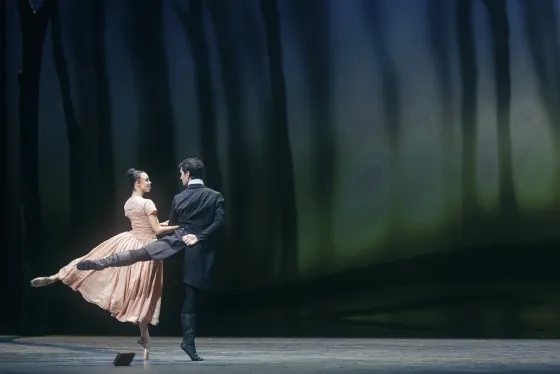
'Eugene Onegin' at the San Francisco Ballet.
How did you approach this score?
I always work from dramaturgy; I need to know exactly what is happening in each moment of the stage action. The score was written for specific scenes and emotional states, not as general-purpose music.
At the same time, I allowed certain traditional dance forms to appear where the story required them, such as in large ball scenes. But harmonically and orchestrally the language is entirely my own and contemporary. I am drawn to dense textures, tension, and extreme emotional states, and the orchestra gives me a physical space to explore them without words.
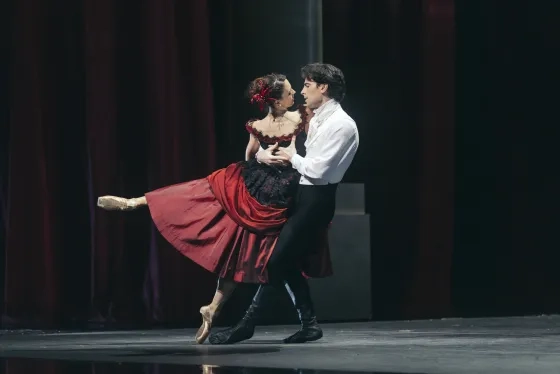
'Eugene Onegin' at the San Francisco Ballet.
Did the piece change much when you began rehearsing with SFB?
Refinement in rehearsals is usually practical and collaborative, so large-scale revisions are rare. Sometimes a section needs to be slightly extended or shortened to fit stage timing. But the core musical form remains intact. For me, rehearsals are less about rewriting and more about integration—seeing how the score breathes together with choreography, space, and performers.
In any rehearsal process, what I value most is the participation of the musicians themselves and their openness to achieving the best possible result. The professional orchestras I am fortunate to work with are always deeply engaged. If there are any doubts about balance, articulation, or phrasing, they help to find the best solution. That dialogue is essential. Music does not exist on paper alone; it becomes fully alive only through the intelligence and sensitivity of the performers.
What advice would you have for any current SFCM students who take your career as a model?
First, focus on craft. Inspiration is important, but without mastery of form, orchestration, and internal musical logic, ideas cannot fully live. A piece should be clear and convincing from within.
Second, be honest with yourself. Do not try to write in a style you think is expected. Your background, your "accent," your personal history—these are not obstacles, but part of your voice.
And finally, understand that theatre and large collaborative forms require listening as much as speaking. You must be able to defend your artistic ideas, but also to hear others and search for solutions that serve the whole work, not only your own ego.
Learn more about studying composition at SFCM.