SFCM Celebrates 5 Years of Bringing Music to San Quentin
Voice faculty Matthew Worth leads the annual project that has SFCM students working with Musicambia, an organization that brings music to incarcerated men across the country.

Every January, Voice faculty Matthew Worth goes to prison.
Technically, though, San Quentin is now a rehabilitation center, one that's been musically famed for a while: It's the site of Johnny Cash's first actual "prison concert" and a Metallica music video. And for five years now, Worth has partnered with an organization called Musicambia for a songwriting workshop at San Quentin during SFCM's Winter Term, in which he and students work with incarcerated men as they craft original songs and compositions. SFCM students play in groups with the San Quentin students and offer guidance on everything from song structure to instrumental and vocal technique.
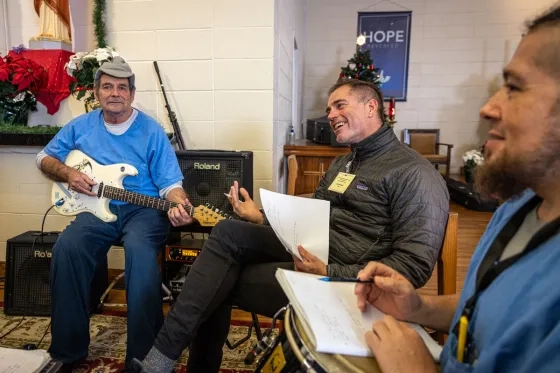
Matthew Worth (center) at San Quentin in 2024.
Musicambia was founded in 2013 by Nathan Schram, a two-time Grammy-winning violist and composer/arranger. Through a post-grad program, he wound up playing a concert at NYC's own infamous prison Rikers Island, which he now calls "the most meaningful performance I'd given up to that point in my life."
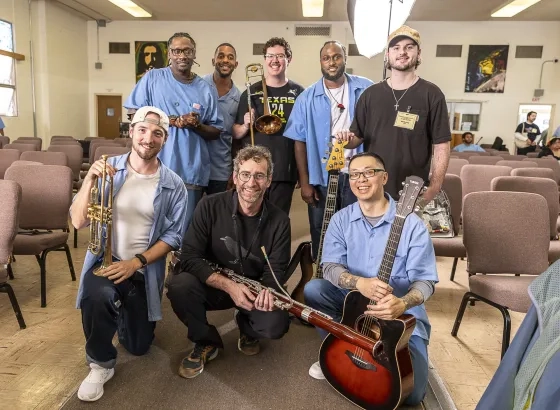
SFCM students at San Quentin.
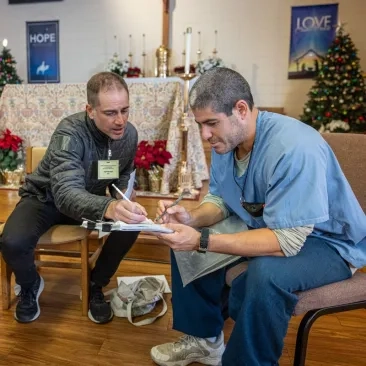
Voice faculty Matthew Worth at San Quentin Rehabilitation Center.
Schram took Venezuela's El Sistema program, a government-funded music education initiative, as one of his models, and he became the first American to visit Venezuelan prisons with núcleos (music schools operating within the those institutions). Musicambia's pilot program was New York state's maximum-security Sing Sing Correctional Facility. Ensemble Connect helped Schram sort out the red tape, and he raised funds to buy as many instruments as he could, the beginnings of a program that now has a massive waitlist of incarecerated people seeking to join and since expanded to prisons in Indiana, South Carolina, Kansas, California, and throughout New York.
Roots, Jazz, and American Music (RJAM) pianist Abner Sahaid (who studies with Edward Simon) called the experience of working with the men at San Quentin "life-changing." He continued, "I cannot express how important it is for these programs to exist," he said. "I made amazing connections with the participants, some of whom opened up about their past with me, which made me believe in second chances and completely go against the way society has painted these men. They had the utmost respect, kindness, and ambition to create art. I would do it again and again and again."
Another RJAM student, trombone player Graham Houpt, added, "I'm not sure I've been around any group of people, including at the Conservatory, more excited to create music together than at San Quentin. Nobody there is taking music for granted, something I didn't even realize I was doing until I worked with these amazing musicians."
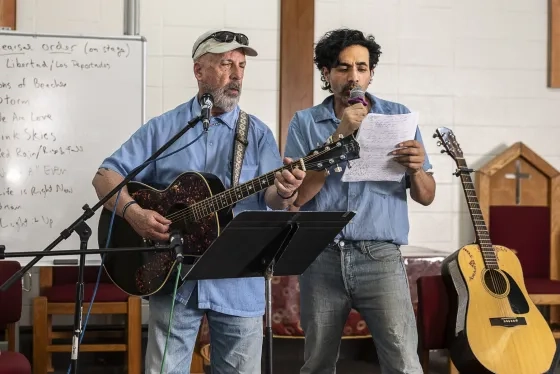
Incarcerated men at San Quentin Rehabilitation Center perform their music.
Worth is also struck by progress made by one incarcerated man in particular: Brian Conroy. "Brian is one of the musicians who came to us with a background in instrumental Western classical music," Worth said. "So he had this great opportunity for him to workshop music with Conservatory musicians who could sight-read and play his work."
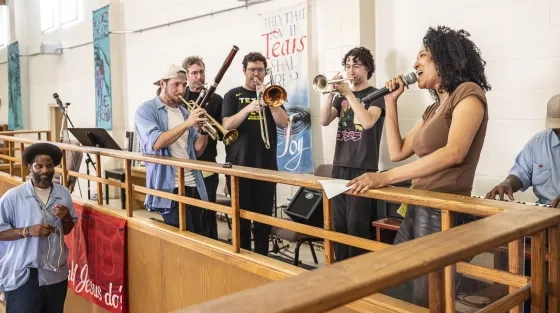
"The first year Brian had a small bassoon and trumpet piece," Worth remembers. "This year he came to us with a full-on octet written for two trombones, a couple of trumpets, bassoon, percussion. It was well-written, with some Minimalism-esque repetition of certain lines within the confines of the meter. It was like playing down a movie score. So what we've seen is this encouragement for the incarcerated guys to have their creative energy encouraged and grow in between our visits." (Another Musicambia student, Joseph Wilson, wrote an entire opera in prison, aided by frequent SFCM collaborator and Opus 3 artist Joyce DiDonato.)
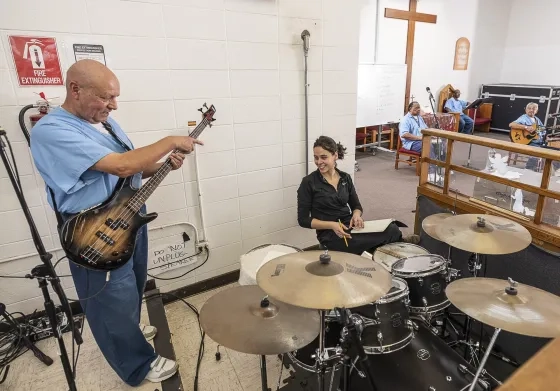
RJAM drummer Tania Cosma at San Quentin Rehabilitation Center.
Musicambia collects feedback from its students after the workshop, and the role music plays in rehabilitation is striking. Reflecting on the process of bringing a song to completion, one man said, "It helped me with patience and hard work and realizing that I can make it pay off in the end with determination." Another simply wrote that the Musicambia "helped me to grow in my goal of building a better relationship with my musician father."
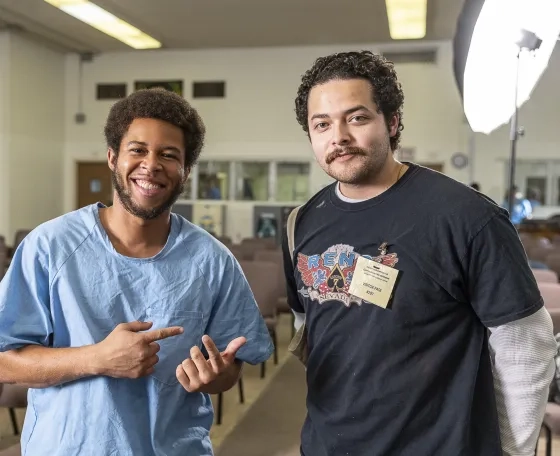
Student Abner Sahaid with a Musicambia student at San Quentin.
Although Worth admits that, "by design, we never go and look to see what it is that got them in there, so I only know what I experience for four to five hours, a few days out of the year," he adds, "every single participant that I've seen has been rehabilitated." He continues, "These guys are outstanding, intelligent, and hoping to be contributors to society. There's nothing that I wouldn't try to do for them."
One man's comment put it simply: "Musicambia taught me what love and magic really mean."
Learn more about Winter Term or studying Voice at SFCM.