How SFCM's TAC-Sony Partnership Gets Grads Jobs
Sony is but one of SFCM's technology partners in the Bay Area; others include Dolby, Meyer Sound, and Roger Linn Design.

Cullen Luper records at SFCM.
Every semester, the Technology and Applied Composition (TAC) Department's Sony Project tasks students with creating a score for a proposed video game. Once the writing is done, students see their projects recorded in SFCM's flagship Studio G by their peers or collaborators—like the GRAMMY-nominated Quartet San Francisco—and receive feedback from their classmates, SFCM faculty, and Sony employees like Peter Scaturro, Director of Music at Sony Interactive Entertainment America.
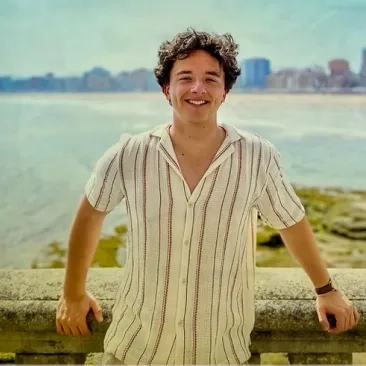
Cullen Luper.
And for several students, their work with Sony continues long after they've hung up their cap and gown.
2025 graduate Cullen Luper is one of them. After graduating, he gigged heavily around San Francisco, and wound up joining Quartet San Francisco for some performances, having impressed the group when they visited SFCM to work on the Sony Project.
"They gave me a super-intense sight-reading challenge," Luper recalls, laughing. "I ended up joining them pretty much immediately after I graduated and kept busy playing and teaching. But all the while I was working on finishing and putting the finishing touches on Unbound, this project Udit Srivathsan did our senior year." (Srivathsan, who became a go-to spatial audio mixer while at SFCM, was hired by Sony in December 2024, before he graduated.) Intended as a portfolio piece, Luper and Srivathsan stretched the work into a complete album, and Luper shared it with some of the people he'd met via the Sony Project: "I just sent them an email like, 'Hey, this is the finished product, hope you enjoy! Thanks for your tutelage over these years. By the way, if you guys want any help down here, I'm around and let me know.'"
While on tour with Quartet San Francisco in New York, Luper said he got a call from Scaturro asking him to interview. "Pretty much, by the time I got back from New York, it was, 'OK, you start in two weeks.''
Luper works as an Associate Music Designer, and explains, "This department is the bridge between the developer and the composer. These hundreds-of-millions-of-dollars-budget-level games have so much to coordinate, so we're not only producing some of the music, but taking the pre-existing composed works and making it work within the game."
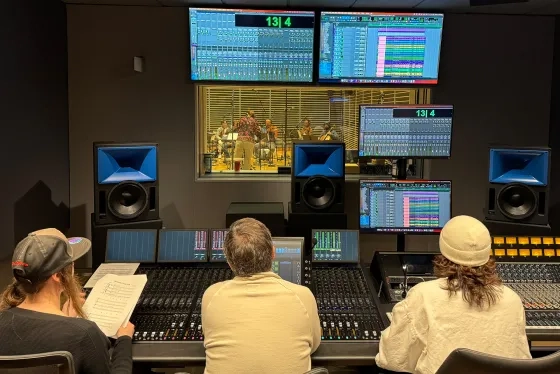
Daria Novoliantceva conducts Quartet San Francisco for the Fall 2023 Sony Project at SFCM.
"Making it work" entails not only standard audio processing like mastering, but editing the written music to work throughout a game that will take much, much longer to play than its score would take to listen to. "A game is 40 hours long," Luper says, "and that's kind of an impossible task to ask of a composer."
"So," he continues, "the composer writes pieces of music directed by someone who's acting kind of like a music producer: 'This is this character that we want to sound this way, this is this emotion, this is this situation—now write music that matches that.'"
At that point, Luper says, "composers usually write anywhere from like two hours to four hours of music, and we end up turning that four hours into 20 or more hours by taking the individual pieces—the audio stems of the compositions—and slicing them up and stretching them across the whole gameplay experience." That process also includes middleware that helps developers and designers map music directly into the game's software, which TAC students are exposed to while at school, though Luper explains he's working mostly in Pro Tools at the moment.
Aside from Srivathsan, another TAC graduate, Britney Dawn Do ('26), works as a dialogue coordinator for Insomniac Games, a subsidiary of Sony. Lastly, 2020 TAC grad Seira Ishimura McCarthy worked for Sony for a few years before moving to Japan to work as a music designer for Kojima Productions. Death Stranding 2, the wildly popular game that McCarthy tapped several SFCM faculty and grads to work on, recently won eight awards at the Game Audio Network Guild Awards.
Meanwhile, of his work at Sony, Luper simply sums up, "It's really cool being on the ground level of working on these things."
Learn more about studying Technology and Applied Composition at SFCM.