Veteran Bay Area Fight Choreographer on Teaching SFCM Students to (Fake) Fight
Dave Maier is a longtime collaborator with the San Francisco Opera whose two classes are vital to students preparing for a life onstage.

Dave Maier (right) at a San Francisco Opera event (Credit: Kristen Loken).
Between stabbings, poisonings, and all-out brawls, opera can be a bloody business, but not when Dave Maier's on the job.
Maier teaches two courses at SFCM that don't immediately spring to mind when one thinks of opera training, but are nevertheless vital: Stage Combat and Swordplay for the Stage. They're skills that most students don't envision when they think of studying opera, but Maier says the basic concepts he teaches are almost unavoidable in a performance career.
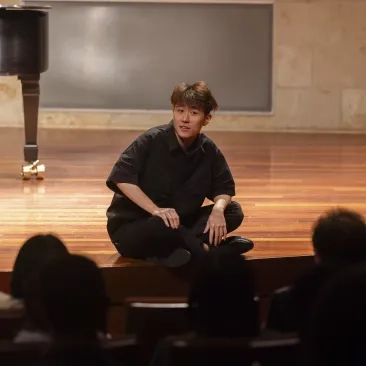
Junzhe Zhang.
"Falling down is one of the big ones," Maier points out. "Characters will have to faint or take a fall even in shows that are not necessarily fight-heavy, so we learn how to fall safely. For example, there's a sit-fall, where you learn how to fall sequentially and open your hands so that you don't injure yourself. That's a basic thing that we cover in class."
"Safety is the first thing," student Junzhe Zhang, a Voice student studying with Catherine Cook, says. "For singers you need to learn how to fight while at the same time, protecting your voice."
Zhang has taken Maier's classes and frequently assists during class. There's a bit of a personal dimension to his interest as well. "I'm from China and my mom was an actress," he explains. "Stage combat is not so popular in China, so I would hear about accidents, and when I'd watch her rehearse, I would think, 'Okay, there's some lack of safety techniques there.'"
Maier got into his field after being repeatedly typecast as "a cop, a soldier or a thug" while doing theater in New York, but got serious about advancing through the levels of certification via the organization Dueling Arts International. That meant training in how to stage unarmed fights and duel with (among other things) broadswords, rapier and daggers, single rapiers, smallsword, and quarter-staff—along with, in many cases, whatever's laying around. "Unarmed also includes fighting with found objects," he explains. "I'm often hired to do a show that says, 'She picks up a frying pan and hits him with it.' We also do a section on comedy violence, like the Three Stooges."
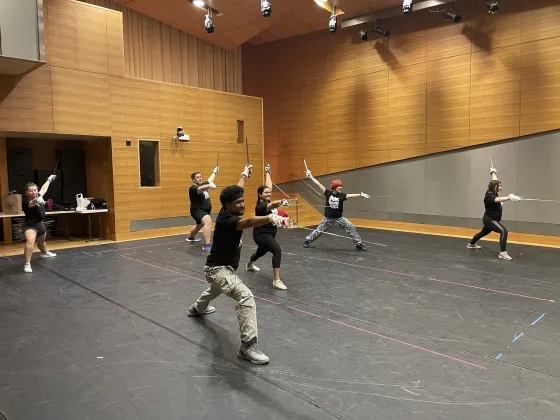
Students work with daggers and rapiers in one of Dave Maier's classes.
Staging combat is not the same as actually fighting, and Maier is keen to point out that what he teaches does not translate past the stage. ("If you use these skills in real life, you're going to get clobbered.") His work is all about creating the illusion of fighting to serve the overall story.
"The first thing I do is talk to the director of a production about what their vision is for a given scene, and then I'll go to the artist to ask them what they're seeing, and then we really just get clear on the specifics of how the action is serving the story," he says. "An example, in Romeo & Juliet, Benvolio is a skilled fighter, but in his scene, he's trying to stop the fight, so he'll have one style, versus Tybalt, who's actively trying to kill someone." Ultimately, his work is still to serve the story: "Working with a performer, we can make a more interesting, more detailed story if you have this training."
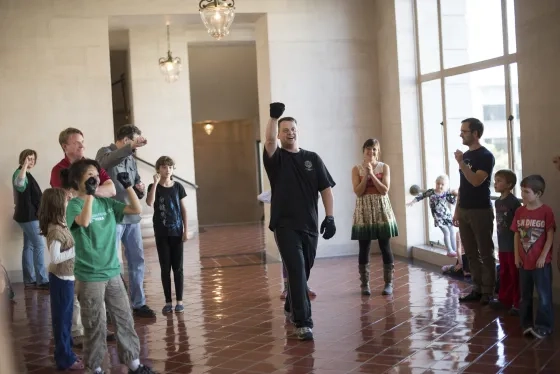
Dave Maier (center) at a San Francisco Opera event (Credit: Kristen Loken).
The physicality Maier teaches translates into character work as well, Zhang says. "I'm transitioning to tenor now, but I used to sing a lot of baritone, and most of those characters are relatively evil or aggressive. So you need to build the character's physical side for that." He adds that there are cross-training benefits to developing physicality as a singer: "One of the reasons I started martial arts was because it helps you gain awareness of your body, and that really helps my singing, because the way you move your body helps your breath."
"For most of us," Zhang continues, "one of the big difficulties is to move and sing at the same time. We practice a lot of dialogues with stage combat movements because it's a good way to force yourself to do two things at the same time."
As the resident fight director with the San Francisco Opera, Maier is a great resource for tips ("If you're supposed to be fighting, say, a giant dragon or robot, you have to make sure that you're fighting the creature, not the puppeteers") as well as stories from complex productions like new SFCM Composition faculty Jake Heggie's Dead Man Walking, which opens with a fight scene in which two characters are naked. (For unique situations like this, Maier's work overlaps with that of the production's intimacy coordinator.)
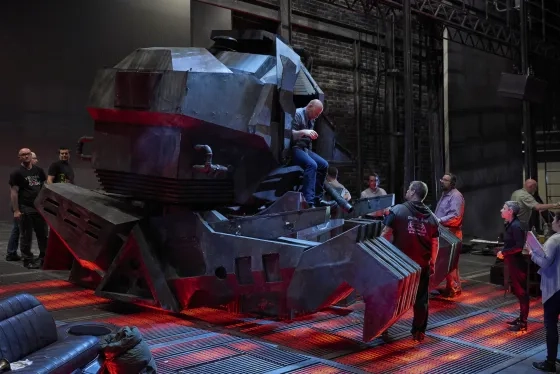
Dave Maier (right, in black hoodie) at an SFO rehearsal for 'Siegfried' in 2018 (Credit: Stefan Cohen).
But students in Maier's classes aren't taking things that far. Stage combat can be a key to a more holistic view of how live theatrical performances work, visually and physically, Maier explains. "We start with really basic stuff, like lines, distance, and how those relationships work with different proximities to the audience. My hope is that when these singers go out into the world, they understand these concepts so that they can convincingly and instinctually know how to create the illusion that they're trying to create."
Learn more about studying Voice or Opera and Musical Theatre at SFCM.