SFCM Sells Out SFJAZZ for Side-by-Side Concert Celebrating Miles Davis
SFCM students frequently play side-by-side with members of the SFJAZZ Collective, and perform regularly in the venue's Joe Henderson Room and Robert N. Miner auditorium.

Roots, Jazz, and American Music students perform at SFJAZZ.
San Francisco's known for its occasionally cool weather, but nothing's cooler than Miles Davis.
The city's famed SFJAZZ venue is celebrating the centennial of the iconic trumpeter's birthday on May 26 with a series of tribute concerts, and SFCM's Roots, Jazz, and American Music (RJAM) Department have already sold out their part of it: A side-by-side concert with student ensembles led by RJAM Executive Director Jason Hainsworth and faculty members Helen Sung (piano) and Anthony Hervey (trumpet).
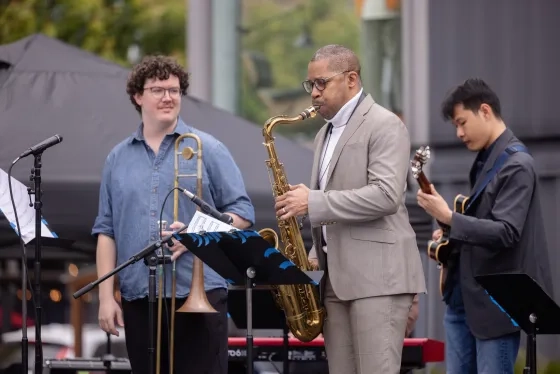
Student Graham Houpt (trombone) plays at the SFJAZZ Festival with Jason Hainsworth (saxophone) and Tri Pham (guitar).

Summing Davis' influence on music is a nearly impossible task. "Miles possessed a rare combination of supreme intelligence, unapologetic individuality, style, and a musical vision that changed the course of music several times and continues to inspire generations of musicians and listeners," Hervey (right) says. Trombonist Fernando Serrano, playing in Hervey's ensemble, adds, "Miles was not only a musician, but a curator. The way he played and arranged music spoke to my heart directly. His music will live on for another 100 years."
"Miles Davis is a force of nature, his music enduring and timeless," Sung adds. "Fearless in his artistic exploration and expression, he transcended categorization and limitations to build a brilliant legacy resounding with freedom and swagger. Happy centennial to Miles—the first, I'm sure, of many!"
RJAM side-by-side concerts are a unique setting for students that parallel the real-life playing opportunities that can pop up with little notice for working jazz musicians. Although the groups spend weeks playing with each other, repertoire isn't decided until shortly before the concert (although in this situation, the groups will be playing some of Davis' music). "This is really supposed to be like a residency, where you meet people and bring in your charts," RJAM Assistant Director Amelie-Anna Hinman says. "That pressure cooker is a very realistic vision of what the music industry looks like at the moment."
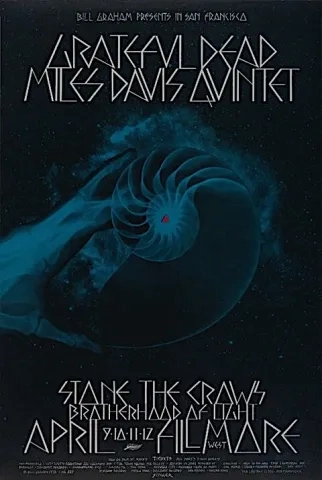
Poster for Miles Davis' and Grateful Dead at Fillmore West.
Davis has an important history with San Francisco. His first-ever live album was recorded at the popular jazz club, the Black Hawk, in SF's Tenderloin neighborhood, though a different SF club looms larger in Davis' life.
Davis' 1969 album Bitches Brew was a radical departure from his previous sound, leaning heavily on electric instruments, dense layers, and tape-spliced edits of lengthy improvisations. Jazz fans and critics rebelled, labeling Davis a "sell-out" for what they saw as caving to the commercial pressures of rock music. But his record label put him in touch with Bill Graham, the live music impresario who created much of San Francisco's defining sound in the 1960s with his club the Fillmore. Graham booked Davis on several bills he put together, and their partnership ultimately resulted in the unlikely pairing of Miles Davis and the Grateful Dead for a four-night run at the SF Fillmore in April 1970. That show was later released as Black Beauty: Miles Davis at Fillmore West, and Davis returned to the Fillmore for four-night runs in October 1970 and May 1971.
RJAM tenor saxophone student Trent Horio nodded to Davis' "big ears." "Miles's artistry is a great inspiration to be open to what's happening in the present to keep pushing the music forward and try new things. His versatility within the bebop, cool, hard bop, modal jazz, avant-garde, and fusion era serves is a testament to how we as artists should be well-versed in playing different styles."
Next up from RJAM: Billy Childs' April residency, which includes an SFCM Big Band concert that will also see the premiere of the Emerging Black Composers Project's inaugural Jazz Prize winner Jordyn Davis' work.