Students Recall a Typically Transformative Jake Heggie Masterclass
Heggie also taught a semester-long course on his opera 'Dead Man Walking' and toured students through the San Francisco Opera production of his famed work.

Jake Heggie and student Shuke Liu.
It's barely been a year since Jake Heggie joined SFCM, but you wouldn't know it from the impact he's had in that time.
"Going in, it's like, 'We're going to meet Jake Heggie. The GRAMMY-winning Jake Heggie. But there's something so immediately personable about working with him," Voice student B Schaubhut says. Schaubhut, who studies with Matt Worth, also took Heggie's semester-length fall 2025 course on his iconic opera Dead Man Walking, which included a visit from the current production's stars and a backstage look at the San Francisco Opera's staging. Heggie's February masterclass at the Conservatory gave the community a close-up of his personal, relaxed approach.
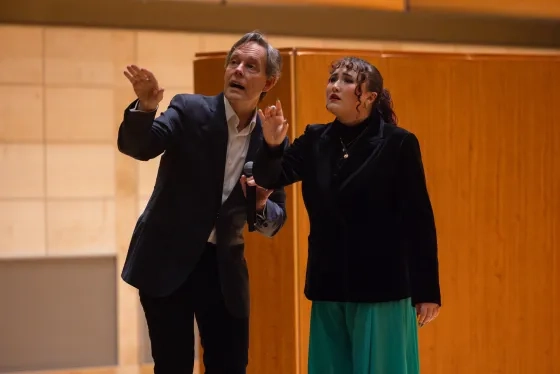
Jake Heggie and student Jordan Riek.
"He's a great person," mezzo-soprano Jordan Riek, who also performed in the masterclass, adds. "That shines through in his music and it shone through the class. Riek had been singing one of Heggie's compositions, "The Haughty Snail King," for years, and explains, "When they told me, 'You're gonna sing at this masterclass,' I just about screamed. I was really excited. I had to call my mom and my dad like, 'You're never gonna guess… It was really a very special experience for me." (Riek studies with Susanne Mentzer.)
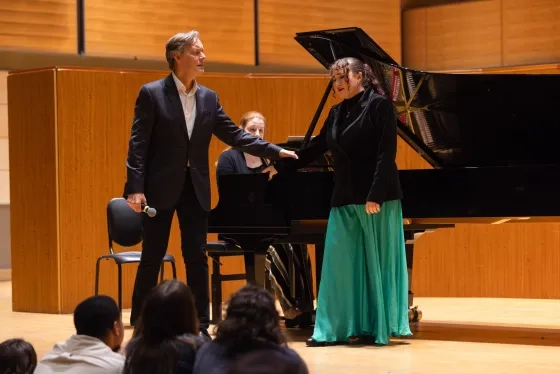
Jake Heggie and Jordan Riek.
Masterclasses can be an intimidating experience: Students are usually performing well-known parts of their instrument's repertoire for professionals who've had years—in some cases decades—of experience with the piece. With Heggie (officially part of SFCM's Composition Department) at the helm, that pressure is compounded by the fact a student is singing for the composer of the piece, though he's well-aware of that dynamic and makes a conscious effort to get students (and audiences) out of it.
"It's always about getting out of your own way, whether you're a composer or a performer," Heggie explains. "Especially in your school years, you have to try to perfect your technique—but that's with the goal of being able to not think about it while you're performing. So part of my job in a masterclass is to take people out of their comfort zone and give them a different kind of challenge: Remember why you love singing, performing, or writing. Get out of your head, go back to your heart and feel what this is about and why you were drawn to it in the first place."
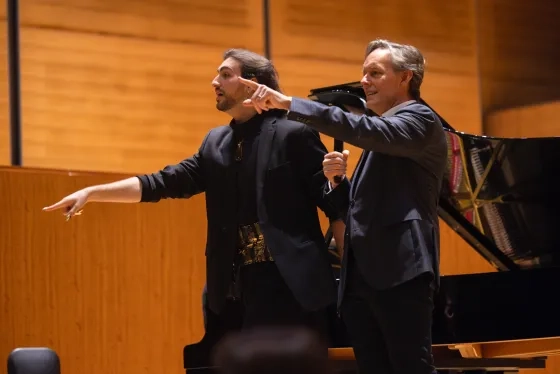
Student B Schaubhut and Jake Heggie.
For Schaubhut's portion, that entailed finding out who in the audience had a birthday and instructing the baritone to lead the audience in a rendition of "Happy Birthday." Heggie says, "When you're singing 'Happy Birthday' to someone, you're not thinking about technique, right? My job is to get people out of that zone, so maybe I dance with them, or I have them do a silly accent so they're laughing. Then when they come back to the piece, it's going to have different energy, because they're now a joyful vessel and able to express anything."
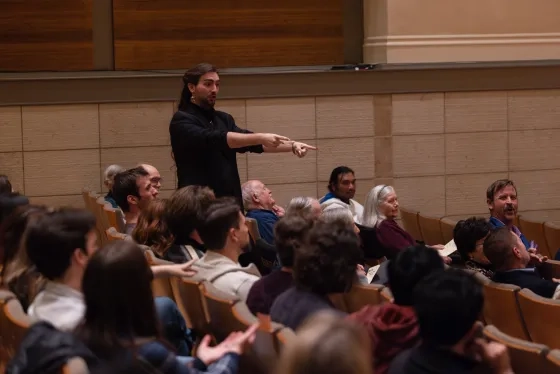
Student B Schaubhut in a Jake Heggie masterclass.
Schaubhut remembers the moment well. "I ran around and I made everybody sing, and I stayed in the audience and sang. But Jake clocked my tea pretty quickly: He was very kind about it, but he saw that I had this sort of barricade up of 'Haha! I'm a stage performer and I'm doing a fun thing!' I was being tongue-in-cheek instead of as intimate as the song required with the audience." After several rounds, Heggie told Schaubhut to sit directly in front of one woman, look her directly in the eye, and sing the song again.
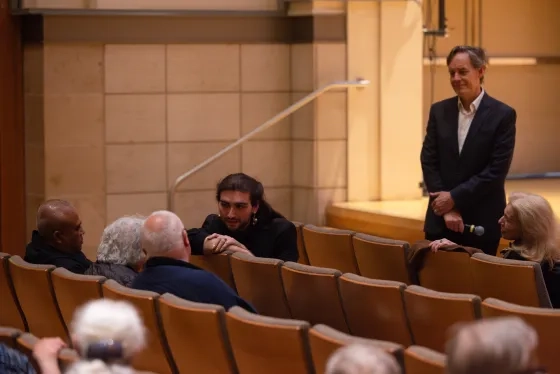
Student B Schaubhut (seated) and Jake Heggie.
"I started singing to her," Schaubhut remembers, "and I like, locked in with her personally, psychically…. I felt like a little pebble in a rushing river of this woman's experience of her life. And that was what Jake was trying to get out of me: this intense, immediate, intimate connection with the audience."
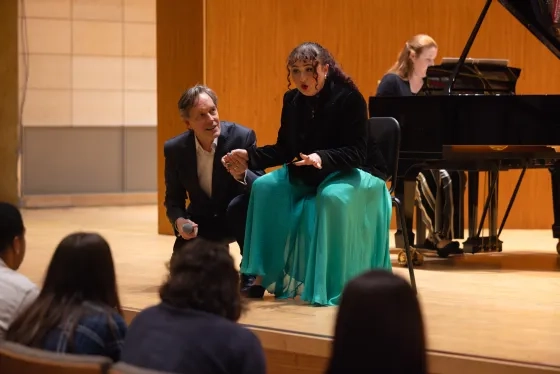
Jake Heggie and student Jordan Riek.
Riek was the aforementioned "silly accent" person. "I finished my run-through and Jake says, 'I can tell you've done this: It's choreographed, rehearsed, prepared,' so he asked me if I could do it in a New York accent. I thought, 'Oh my God, this is so scary.' But if Jake Heggie asks me to do an accent on stage, I'm going to do it. So he put me out of my comfort zone, but it really brought up some really great things and grounded my body in a way that I wasn't anticipating. And I sang so much better after that."
"It's like being in the shower or walking, biking, swimming," Heggie likens his process to, "and you get an idea because you're not locked down into a certain mindset about 'being creative:' You're opening up all the channels through which things can pass. Our job as performers and creators is to try to be open, because then it stops being about us and about the music and the connection with the audience."
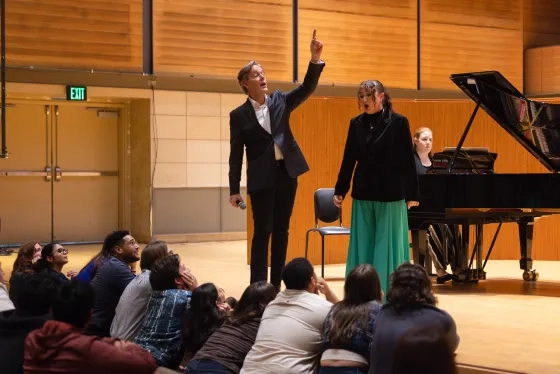
Jake Heggie and student Jordan Riek.
But Riek's out-of-the-box experience wasn't through. "This was so cool for me as a person who has a background in education: He asked what I thought about the piece and what I imagine the narrative is, and I said, 'I'm telling a bedtime story to children'. So he says, 'Well, then we need a bunch of children for you to tell this bedtime story to,' and asks the audience, 'Who wants to come and be a little kid for Jordan to sing to?'
"And a bunch of my friends came down," Riek continues. "It made me emotional: All of the people at school who support me and who I support and who are in all these rehearsals with me… all the people who I love and who I've connected with were suddenly part of the piece, and that was pretty spectacular."
Learn more about studying Voice or Composition at SFCM.