Canadian Brass Visit SFCM for Masterclass and Q&A
Founding member and tubist Chuck Daellenbach and trombonist Keith Dyrdra focused on SFCM's low brass players during this visit.

Keith Dydra of Canadian Brass.
Arguably the most famous brass quintet in the world, Canadian Brass, visited SFCM in March for a masterclass that focused specifically on the lower frequency members of the brass family, led by founding member and tubist Chuck Daellenbach and trombonist Keith Dydra. Trombonists Thomas Valle and Ella Buonassisi played Paul Hindemith's Sonata for Trombone and Piano and Darius Milhaud's Concertino d’Hiver Op. 327, respectively; bass trombonist Ryan Liu played through a wide range of orchestral excerpts, and tubist Massimiliano Castor rumbled the floorboards with Robert Schumann's Fantasiestücke, Op. 73.
After a class filled with all the brass in-jokes and repartee CB is famous for, Dydra and Daellenbach were kind enough to answer the SFCM Newsroom's questions as a duo.
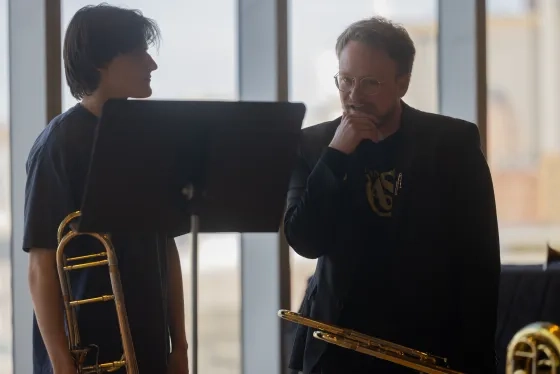
Keith Dyrda of Canadian Brass with an SFCM student.
How has your approach to teaching a masterclass changed over the years?
Canadian Brass has found that as the years have gone by, the quality of teaching has skyrocketed in school programs and college music programs. Our workshop should become less about technique and much more about quality of performance, opportunities of performance and creative thinking about futures in music.
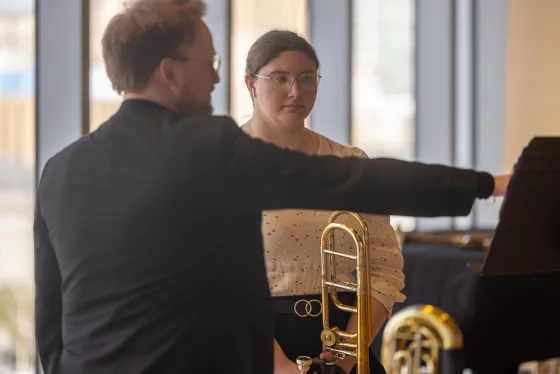
Student Ella Buonassisi in Canadian Brass' SFCM masterclass.
How do you "triage" things you'd like to address in a student's playing in a masterclass setting?
We always remain aware that a workshop is as much about the audience as the performers themselves. This is a shared experience and one that, we hope, illuminates doable aspects of improvement of performance, quality of practice, and value of ensemble performance.
How do you find SFCM's Brass students, generally?
As we hoped—and frankly expected, given the SFCM's reputation—the students we heard performed at a very high level and displayed a mature sense of musicianship. They were all incredibly responsive to our input and were able to adjust on the spot in front of a keen and attentive audience. The experience was as enjoyable for us as it hopefully was for the students.
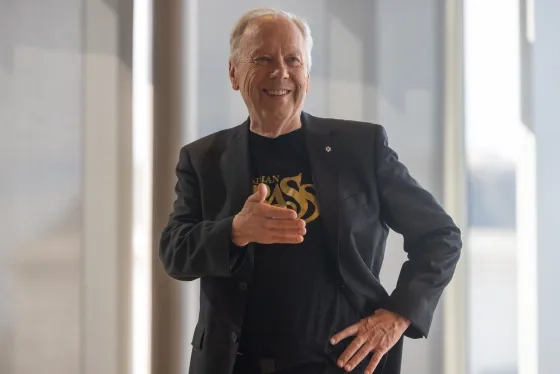
Chuck Daellenbach of Canadian Brass at SFCM.
Do you have any funny/odd/noteworthy memories of masterclasses you played in as students?
Besides the odd person passing out in the middle of class, strangely I [Keith] haven’t witnessed too many out-of-the-ordinary masterclass moments.
I did, however, manage to set myself on fire at the end of my Canadian Brass audition. An oddly placed candle quickly ignited the hood of my winter parka and continued up the back of my head. I had felt I played well in the audition, so when the guys started excitedly yelling, "Keith, you're on fire!" I simply took it as a compliment.
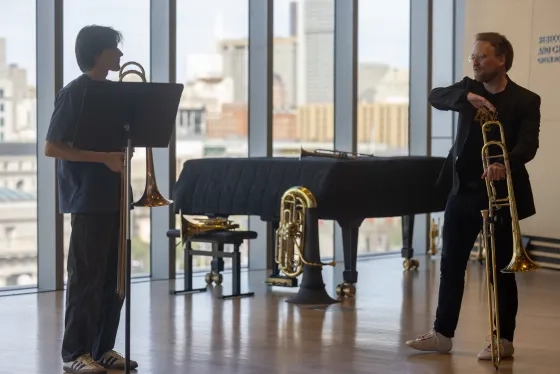
Student Thomas Valle and Canadian Brass' Keith Dyrdra.
Do you have any underappreciated or "deep cut" pieces of rep that you'd like to hear more from brass or low brass students?
Of course, we are very proud of the music that we have created for brass quintet and are eager for other ensembles—and importantly, ensemble coaches—to become aware of the wonderful performing repertoire that has been developed. Unlike string quartets that can depend on centuries of music, the brass quintet is a relatively recent addition to the classical music world. Consequently, we have to be very conscious of the desires of our audiences so brass music can in fact proliferate.
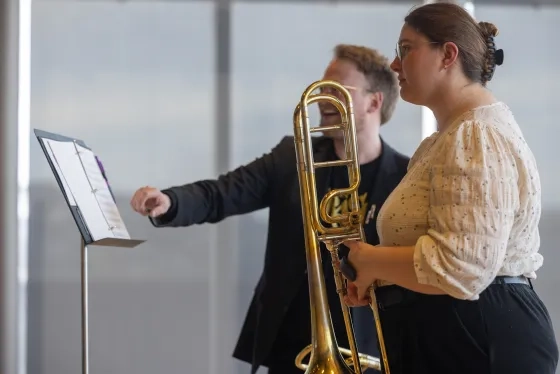
Keith Dydra of Canadian Brass and SFCM student Ella Buonassisi.
What's one piece of absurdly specific low-brass advice you can share?
Never forget to breathe! Sometimes we mimic a trumpet that uses a quarter of the amount of air in performance that we do and we start to starve the sound we’re making.
What advice would you give to students who look to your career as a model?
Always be open to opportunity and make sure that you perform frequently. Every chance one gets to perform for other people will make the whole process easier. We pretty much start on our own and then realize it's the sharing of music that is really rewarding.
Learn more about studying brass at SFCM.