Wed
Oct
28
(She/Her)

Education
The Curtis Institute of Music
MMus, Royal College of Music
Artist Diploma, Conservatoire National Supérieur de Musique et de Danse de Paris
Konzertexamen, Hochshcule für Musik und Tanz Köln
Ensembles
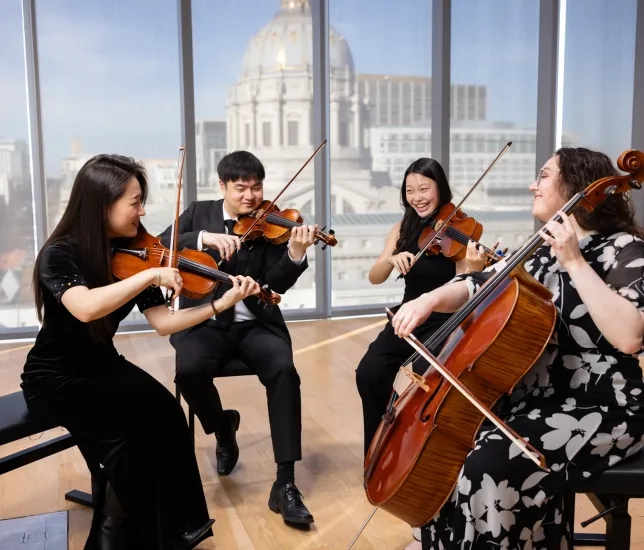
Esmé Quartet
Awards and Distinctions
1st prize, Wigmore Hall String Quartet Competition
1st prize, Lipizer International Violin Competition
HSBC Laureate
Prize winner, Geaorge Enescu International Violin Competition
What is your hometown?
Busan, South Korea.
What are you passionate about outside of music?
Home cooking, writing, learning foreign languages.
What is a favorite quote that you tell students?
Believe in yourself and play fearlessly when performing, but when at practice, be humble!
What was a turning point in your career?
When my quartet won the first prize at the Wigmore Hall String Quartet Competition, my life dramatically changed and I started living as an active performer.
If you weren't a musician or teacher, what do you think you would be doing now?
I am fascinated with public speaking and I love having a good conversations with interesting people. So perhaps a television show host or a producer!
What was the defining moment when you decided to pursue music as a career?
I started playing the piano first at age 5, and the violin at age 7. At first, I wanted to become a pianist, but my piano teacher was quite scary, and I cried a lot after my piano lessons. But then when I met my violin teacher Sunny Lee, the director of Seoul Central Conservatory, she was so warm and caring that she really inspired me to love music. A good teacher can be a big influence in one’s life and I would like to try to be the kind of teacher who can inspire my students.
What is your unrealized project?
I always wanted to lead a project called <open call for female composers> where my quartet hosts an open audition for any female composers who would like to write good quartet music and perform them. Hopefully it can become a reality soon!
What do you think makes a concert experience unique?
When a performer has something interesting to say about music, and the audience is open-minded about that storytelling, it can be very spiritual and mesmerizing!
What are your most exciting collaborations?
Playing John Adams' Absolute Jest with Adams himself conducting in Tokyo and performing Schubert's Quintet in C Major with the cellist Lynn Harrell.
What recordings can we hear you on?
I have two recordings on Alpha Classics Label with my Esmé Quartet. The first one is called To Be Loved, which consists of all the first string quartets from Beethoven, Frank Bridge, and Unsuk Chin. Then the second one is called Yessori, which means "sound from the past" in Korean. It includes one Korean work which is about Haegeum, the Korean traditional string instrument.
What is your daily practice routine?
I do a lot of score studies. So I spend a lot of time thinking about music rather than physical practice. But of course some scales (three octaves, thirds and octaves) and different etudes a day are not a bad way to warm up before getting to repertoire for performances.
Wonhee Bae is internationally recognized as one of today’s leading violinists and chamber musicians. Acclaimed for her expressive musicality, refined artistry, and versatile career as both soloist and ensemble musician, she appears regularly at major concert halls and festivals throughout Europe, Asia, and North America. Based in San Francisco, she has established herself as a distinctive artistic voice through an international performing career spanning solo appearances, chamber music collaborations, recordings, and teaching.
As first violinist of the internationally acclaimed Esmé Quartet, she has appeared at major venues and festivals including Elbphilharmonie Hamburg, Wigmore Hall, Lucerne Festival, Verbier Festival, Hong Kong Arts Festival, and L’Auditori, among many others. The quartet was awarded First Prize and four special prizes at the prestigious Wigmore Hall International String Quartet Competition and has since established itself as one of the leading string quartets on the international stage.
The Esmé Quartet records exclusively for Alpha Classics. Its debut album, featuring works by Ludwig van Beethoven, Unsuk Chin, and Frank Bridge, received a Diapason d’Or five-star review and was selected as one of the best classical albums of 2020 by WQXR. The quartet’s second album, dedicated to the late string quartets of Benjamin Britten, was released to critical acclaim. Its third album, Nui, featuring works by Fanny Mendelssohn, Felix Mendelssohn, and Juri Seo, was released in September 2026.
Alongside her chamber music career, Ms. Bae has appeared as soloist with orchestras including the Russian National Orchestra, Seoul Philharmonic Orchestra, George Enescu Philharmonic Orchestra, Iași Philharmonic Orchestra, Korean Chamber Orchestra, Busan Philharmonic Orchestra, Philharmonie der Nationen, and the Orchestre des Lauréats du Conservatoire de Paris.
Her international distinctions include prizes at the George Enescu International Competition, the Isang Yun Competition, the Lipizer International Violin Competition, and the International Tchaikovsky Competition for Young Musicians. She was also named the recipient of the Hauck & Aufhäuser Culture Prize in 2013 and received the Ocean Classical Award in 2012.
At the age of fifteen, Ms. Bae entered the Curtis Institute of Music before continuing her studies in Europe. She received her master’s degree from the Royal College of Music under Felix Andrievsky and later studied at the Conservatoire de Paris with Boris Garlitsky and Svetlin Roussev. She completed the Konzertexamen at the Hochschule für Musik und Tanz Köln under Mihaela Martin. Ms. Bae is currently Professor of Violin and Chair of String and Piano Chamber Music at the San Francisco Conservatory of Music. She performs on a 1737 Januarius Gagliano violin, generously loaned by the Kobler-Reinfeldt Foundation.