A Conversation with Lester Lynch About Pedagogy
Acclaimed Verdi baritone Lynch began teaching at SFCM in 2024.

Lester Lynch.
Hailed for his work with Verdi's repertoire, baritone Lester Lynch brought an international performance career chock-full of highlights—Teatro alla Scala, the Berlin Philharmoniker, Russia's Tatar State Opera, Norway’s Bergen National Opera, just to name a few outside of the United States—to SFCM when he began teaching in the Voice Department in 2024. Lynch is also well-represented on the roster of SFCM's partner record label, Pentatone, particularly singing the works of SFCM Composition grad Gordon Getty.
In April, Lynch answered the SFCM Newsroom's questions about pedagogy, performance, and much more.
Could you outline a very general approach to your teaching style?
I want to meet my students where they're at. It's so individualized as far as people's goals—not only what genres and styles they might want to be singing, but the settings in which they're hoping to sing—that there's no one-size-fits-all response to that. We want the voice to be free to do whatever is going to help the story.
I've sung both musical theatre and opera in my career, and I'm still very much in my career, so I have experience with a wide range of styles, and ultimately, no matter what a student wants to sing, it's still going to come from the same instrument. All of us singers might make choices depending on the character, the production, or the mood on a given night, whether that's going to be something technique-focused, like "I'll open up my sound here or add some brightness here," or just deciding to really go for broke at a certain moment—but we always want those choices to be made from a place of an open, confident voice that's not going to be hurting itself.
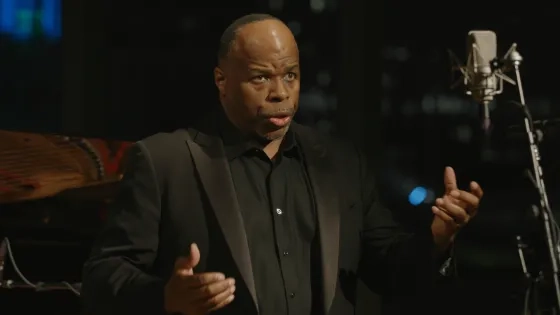
Lester Lynch performs at SFCM.
We had a student come in and sing a recital prep rehearsal for some of us on faculty—and by the way, that's very rare: to have an opportunity to sing for multiple faculty members and get feedback before a recital—and when he began to sing some musical theatre numbers, he changed his whole timbre and focal point of his sound, and my comment was "just keep doing what you were doing." When you think of some of the greats, like Patti LuPone, she's able to sing across all these genres because it's coming from this place of freedom, rather than trying to conform or adhere to any set expectations of genre.
You know, I have two students who are both sophomores, but one of them is 19 and the other is in his mid-twenties. And that makes a difference beyond just where their voice is, physically; it extends to their maturity level, work ethic, and so forth. That's also going to determine whether I'm going to need to focus more intently on intonation or posture, versus someone who has those more squared away because of whatever experience they already have that means we can move on to other aspects of their artistry.
What important information are you looking for from students who want to study with you?
First and foremost, I'm looking for storytellers. That's what we're here to do, whether that's singing opera, musical theatre, jazz—anything. I want to see someone who's prepared to really go there in a performance, to be able to bare their soul to communicate with an audience. There's a certain kind of fearlessness I want to see from someone from the start that will let me know they're going to want to dedicate themselves to craft.
What's your process for assessing where a student "is" musically?
There are certain things that need to be in place, of course—chiefly, an ear. "Ear training" is of course something we teach here, but that's interval recognition, things like that; you can't really "train" an ear for music that isn't there. We can work with almost any voice at any level so long as the ability to hear what they want to do with that voice is in place.
I'm also looking at what I might need to address in a student's physicality. Is their chest closing in, are they holding tension in their jaw or the front of their tongue or the base of their tongue—people are always so surprised when I show them on an anatomy chart how big the base of our tongues are and how that affects how we produce sound! I've also noticed several baritones who have a specific kind of shoulder drop, and I don't know why [laughs]! The voice is not an instrument we can hold, so we need to be very intentional about bringing awareness to all these different areas: I'll have students breathe in with their fingertips on their suboccipital muscles in the back of their head.
I studied a system called Physio-Synthesis that combines aspects of Alexander Technique, yoga, and the Feldenkrais method, and aspects of all of them are tremendously helpful. I have students do yoga stretches, and Alexander Technique is very helpful as far as body awareness, but often, people don't understand the strength that singers need to project into 2,000-foot-long halls. You know, Sherrill Milnes grew up on a dairy farm, doing really strenuous physical work! People were, in general, I think, stronger before the age of keyboards and phones. Those movements collapse your chest, your shoulders, and the angle people fall into while looking at their phones is especially bad for singers. So there's a very physical component to this art that extends beyond the vocal folds and lungs.
What would you tell a student who may be torn between SFCM and another school?
The level of individual attention you receive here as a singer is really unparalleled. There are between 75-85 singers here, and between the Voice, Opera & Musical Theatre, and Vocal Studies faculty, the student-to-teacher ratio is around 4:1. That's not reflective of larger schools where you can kind of disappear, where outside of your studio teacher, the other supportive staff in your program might be your fellow students.
And so many of us are still working professionals: With John Wilson or Margaret Halbig, these are people who step onstage with the San Francisco Symphony, Opera, or any number of the several really high-quality opera houses around the Bay Area. Our faculty are also really generous with their time across studios: A student here from another studio came to me at the recommendation of her teacher seeking help with a Verdi piece, because I've specialized as a Verdi baritone, so now we're working together on that. That's simply not going to happen at many other schools.
Learn more about studying Voice at SFCM.