Alum Makes Solo Debut in San Francisco Opera's Acclaimed 'Monkey King'
2004 graduate Jonathan Smucker made the 'New York Times' write-up of the San Francisco Opera's acclaimed new production, 'The Monkey King.'

Jonathan Smucker (left) as "King of the East" in "The Monkey King" (Credit: Cory Weaver).
Making a solo debut as a king? Par for the course for an SFCM graduate.
Tenor Jonathan Smucker ('04) made his solo debut with the San Francisco Opera on November 14 in its production of Huang Ruo and David Henry Hwang's The Monkey King. Taking its inspiration from the classic Chinese novel Journey to the West, the opera focuses on its titular character Sun Wukong, a beloved figure in Chinese folklore, as he battles on behalf of his tribe, ultimately leading to a confrontation with the Buddha himself.
Smucker plays The King of the East, one of the many mythological figures that Wukong meets (and bests) on his journey. With green-and-blue dyed hair and bright red eyeglasses, Smucker cut a distinctive figure onstage in his scene, and plays the pipa, one of the Chinese instruments that composer Ruo blends with traditional Western music in The Monkey King's score.
"SFCM was a great place for me," Smucker says. "I feel like the combination of close personal attention, ample performance opportunities, and a high professional standard were essential to my development. I also gained a lot of on the job knowledge as a professional while in school, between church jobs, soloist engagements, and professional chorus work, and attended SFO performances as often as I could. Seeing world-class performances on the War Memorial stage was definitely a lesson in excellence!"

San Francisco Opera's "The Monkey King."
His promotion to King of the East, Smucker says, was a multi-year process. Now a tenured member of the SFO Chorus, he began as an extra in the Chorus in 2018, before auditioning for the main Chorus in 2021 and being offered the role of second tenor. "Regular choristers are awarded tenure after their third consecutive successful audition," Smucker explains. "We audition annually and must 'win' our spot three times in a row for tenure, a process that can be a bit of a mind game, especially in the lead up to the final audition. But a tenured spot means I no longer have to audition for the job: It's a long-term, career-length post, and I feel lucky to have it!"
To prepare for the role, Smucker researched not only the source material but several adaptations, including a 1961 Chinese animated film referenced by the opera's creative team, a recent animated Netflix feature in English, and a few different Chinese-language live-action series. "I also had to learn quite a bit of stylized movement and gesture from the choreographer Ann Yee and Peking Opera specialist Jamie Guan," he adds, "and I found myself drawing on my experiences in Baroque movement and gesture work to navigate this new physical language while making it my own."
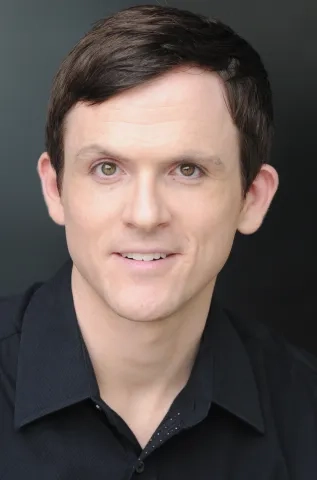
Jonathan Smucker (Credit: Lisa Keating).
The Ohio-born Smucker has a long history of SFCM-associated performances in the Bay Area. He's performed with the American Bach Soloists (whose founder, Jeffrey Thomas, guest-conducted Composition Department Chair David Conte's Faculty Artist Series recital on December 7) and the Philharmonia Baroque Orchestra & Chorale, founded by Laurette Goldberg, who was instrumental in founding what is now the Conservatory's Historical Performance Department. Smucker also sang in readings of Composition faculty Mason Bates' The (R)Evolution of Steve Jobs.
SFCM and the SFO maintain a close relationship pedagogically and professionally. Voice faculty members are active participants in SFO productions, and many also teach in the SFO's Merola and Adler Fellowship programs, among the most prestigious young artist programs in the country, where multiple SFCM alumni have gotten a jump-start to their professional careers.
For singers looking to begin their career in a chorus, as he did, Smucker offers some pointers. "Sing your best repertoire, always—and 'best' and 'most impressive' are not always the same thing! Show your musicality, your tonal stability in all registers and across a full dynamic range, as well as something of your performance persona. Nail the details of music, text, and intonation, and remember that ensemble work is about collaboration—show how you can contribute to the group with confidence and command."
More generally, he tells students and younger professionals who might be inspired by his path, "Work on your craft every day and keep your eyes open for every opportunity. You can learn something from everyone you work with. Be clear about what you want and let that guide your process. There is work out there to be had if you are open to what comes!"
Learn more about studying Voice at SFCM.