Jennifer Ellis and David Garner Discuss Their Composition for Harp Class and New Premiere
Ellis' May 3 Faculty Artist Series Recital also includes pieces from Composition Department Chair David Conte, Technology and Applied Composition faculty Costas Dafnis, and two students.

Jennifer Ellis and David Garner.
A concert harp is a fantastically complicated instrument, as Jennifer Ellis explained to the SFCM Newsroom in 2025. Adding that to the entire palette of colors and instruments available to a composer can be daunting, but that's why Ellis and Composition faculty David Garner have teamed up on a recurring Winter Term class, Composition for Harp, that teaches students to navigate that tricky territory.
The collaboration originally began with Ellis visiting Garner's composition class to talk about her instrument, but both musicians were excited not only about the educational aspect, but about the idea of premiering new works for the harp.
"Jennifer had much more to do with the winter term project than I did," Garner quips. "I just had to sit there and pontificate, but she had to practice all of the pieces and then perform them all."
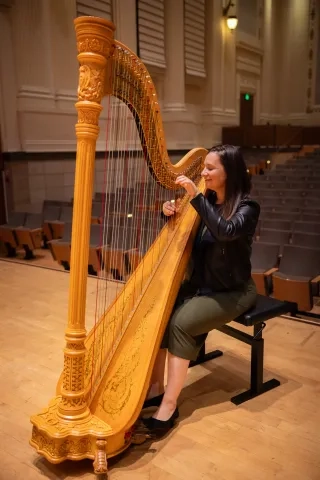
Jennifer Ellis.
A few years later, Ellis will be premiering a three-movement piece by Garner, along with works from Composition Department Chair David Conte, Technology and Applied Composition faculty Costas Dafnis, SFCM alumni and faculty Matthew Cmiel, and students Mukil Narayanan, Mikael Malmgren, and Corbin Genthe, at her Faculty Artist Series recital on May 3. (As if that wasn't daunting enough, Ellis is also performing two pieces she composed.)
Originally, Garner invited Ellis to his seminar "because I have long been of the opinion that certain aspects of the orchestra were, if covered at all, hardly covered—and those would be the harp and percussion. Amongst all of the yearly string, woodwind, and brass projects, the two instruments that are near and dear to my heart were never covered, except when I covered them in my orchestration class, in which you have one semester to cover the entire orchestra."
"The harp is a strange instrument to write for," Ellis allows, "in part because people have less contact with it. It's not like a piano that's in every room. And because there's fewer of us at any given institution, you're less likely to have a harpist roommate who you're able to just ask informal questions to. So it's very easy to get through a lot of musical training with very little interaction with the harp."
In the key of C-flat major, with over 2,000 moving parts, the harp doesn't belong to a family of instruments, like strings, where a cellist will be peripherally familiar with how a viola works, making it particularly tricky to compose for without a relatively high level of familiarity. One thing Garner tells students during Winter Term is that the problems of writing for harp are emblematic of writing for orchestra more broadly, so if students understand resonance and density—some of the common pitfalls of harp writing—they won't "simply" be writing well for harp, they'll be scoring orchestras better, too.
"The other orchestral instruments you really have to deal with in terms of resonance besides harp are the timpani and piano," Garner says. "The thing with the piano, though, is that it's a huge pitfall for composers to think that there's any resemblance whatsoever between the piano and the harp. You can do whatever you want almost instantly in terms of resonance with the piano, because you have three pedals that can control exactly that, but there's hand formations and other things that are absolutely alien to harp writing."
Ellis and her Harp Department peer Katherine Siochi have seen firsthand how the class has elevated the quality of writing they and their students receive. "The parts that our harpists are getting since we have started this project have radically changed, they make so much more sense on the instrument, it's just night and day. Often that's because they're students who have taken the Winter Term class, but I think even with people who haven't taken it, there's been a trickle-down effect across the Conservatory, where there's just more awareness of some of the principles." (This year, Siochi also joined Ellis and Garner's class and performed half of the pieces with her.)
Garner's three-movement piece, Three Spacetimes, is a class in and of itself in harp writing, Ellis says. "Each movement is so distinct, and the whole piece showcases a lot of different aspects of what the harp can do. A lot of our repertoire uses about 15 percent of what the instrument can actually do, and while that 15 percent is lovely, it's still kind of a shame if that's all we get to do in our day. This piece actually uses my full emotional range on the instrument, and that's a joy for me as a performer." (The last movement, "Jaap Eden Hal 1979," is named for a jazz club in Amsterdam where some of Garner's fusion influences played. "It's prog rock," Garner says, "and the bass line really thumps.")
"The more I wrote the piece, the more it became Jennifer's," Garner finishes. "So I really can't hear anybody else playing it."
Learn more about studying Harp or Composition at SFCM.