Students Sing the Blues, Joni Mitchell, and Adele in Olivia Flanigan's Contemporary Vocals Class
Flanigan's class gives students opportunities to pursue singing styles and forms that aren't part of the standard opera or musical theatre repertoire—yet.

Olivia Flanigan (seated) and her Contemporary Vocal Craft class.
Amid the strains of Puccini, Verdi, and Schubert, you may hear a Joni Mitchell or classic blues tune ringing out at SFCM.

Olivia Flanigan.
That's thanks to the Voice Department's Contemporary Vocals Craft class, taught by Olivia Flanigan. Recognized by the jazz magazine, Downbeat, as a vocalist when she was still a student, Flanigan has taught jazz vocals at the Universidad San Francisco de Quito in Ecuador and released two solo albums of original material.
To that end, she's eminently qualified to teach PRF 204, which offers a survey of 20th-century vocals outside of the opera and musical theatre canon. "My interpretation of contemporary music, with my background, starts with the blues," Flanigan explains. "I had the students sing a blues tune, and I introduced them to the blues scale and the 12-bar form." From there, Flanigan explains, students progressed onto a jazz standard—many of which are drawn from the Great American Songbook, a natural progression chronologically from early blues.
But the class wasn't limited to vocals. "I wanted students to have an understanding of what it takes to lead a band outside of the context of classical music, where, for example, often you have agency over what key you might sing something in," Flanigan said. "That leads into the responsibility of a singer in these genres: providing the band with the information that they need to perform and cuing them as to beginnings, endings, stop-time." To give singers a live band to react to, Roots, Jazz, and American Music (RJAM) students Amithav Gautam (guitar) and Kole Dixon (bass) were recruited to support the singers alongside Flanigan on piano.
Flanigan also had students improvise, which can be a big hurdle for musicians trained in a genre that adheres more strictly to the page. "I think it was fun for most of them, even though there was some initial fear. There were a lot of large eyes looking at me like, 'I just met you, and you're going to make me do what?' So, at first we did it together and then they each took turns, and once they were able to get over the fear of it, they were able to be in the moment with it and enjoy it."
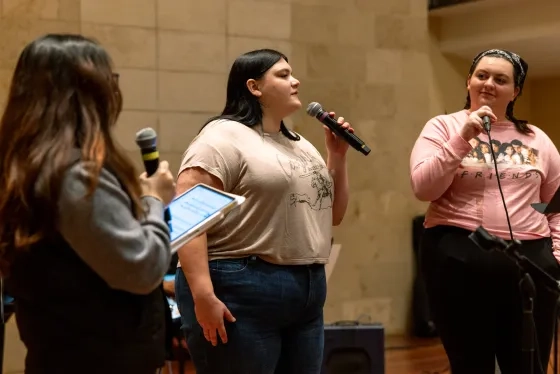
Students sing in Contemporary Vocals Craft.
From blues and jazz, Flanigan moved students into the pop realm, which, in this instance of the class, spanned from Joni Mitchell's "Both Sides Now" to Adele's "Someone Like You." "I really wanted them to really understand form and the chord changes happening behind them," she says. "You don't want to be the singer who doesn't know what's going on underneath your voice: It's important to understand what's going on harmonically and to use your ear. So, I had them create their own charts, but also create harmonies by ear with a partner."
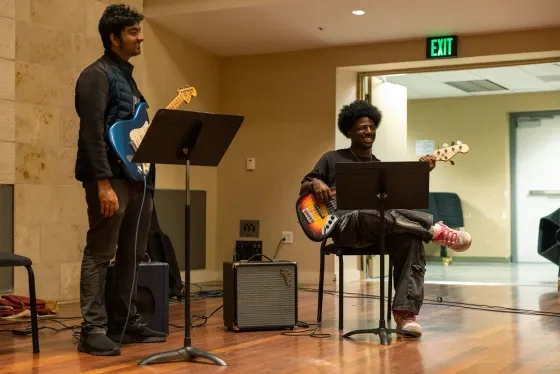
Amithav Gautham and Kole Dixon of SFCM's Roots, Jazz, and American Music Department.
Flanigan echoes other Voice faculty, like Lester Lynch and department Chair Richard Cox, in that no matter what the genre students are singing, there are foundational aspects of pedagogy that remain the same. That said, she identifies a few things that are different: "Belting might not exist in the same way in the classical repertoire students have worked on. They might be used to a darker, resonant-head/ear sound versus a brighter timbre. Even vowel shapes: Listen to a classical singer sing 'I Loves You, Porgy,' vs a jazz singer. We're looking at these kinds of things: Registration, sound quality, vowel shape, and the rhythmic feel from blues & jazz."
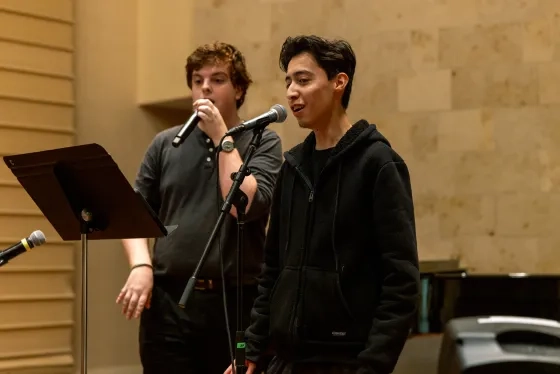
Olivia Flanigan's Contemporary Vocals Craft class.
"If I've learned anything in my career," Flanigan concludes, "it's that I can't just do one thing. If you pigeonhole yourself too much, there will be music you won't be able to sing. Try a lot, and you'll find out what is and isn't your thing."
Learn more about studying Voice at SFCM.