Why the Famous 'Riot' at the 'Rite of Spring' Premiere Was a Setup
'Rite' was fashioned in part as a response to Parisian critics finding Igor Stravinsky and Sergei Diaghilev's previous work 'not Russian enough.'

Igor Stravinsky and ballet dancers in the original production of his 'Rite of Spring.' (Courtesy Library of Congress)
It's one of the most iconic works of the 20th century: In other words, just good enough to close out a season at the San Francisco Conservatory of Music.
Igor Stravinsky's towering Rite of Spring remains a daunting task for any ensemble, thanks to both its tricky rhythms and the long shadow it casts over the next 100 years (and counting) of music.
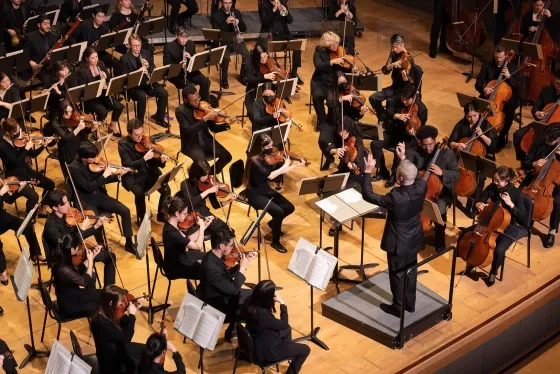
Edwin Outwater conducts the SFCM Orchestra.
SFCM Music Director Edwin Outwater says, "Rite is the piece that changed everything. There's everything before it, and then everything after it, and that impact is still as strong now, a quarter of the way into the 21st century, as it was in 1913."
"Initially, I thought Rite might have just been too big for us to pull off; it wasn't until we did Mahler 6 last year that I felt really confident that we'd be able to," Outwater says. "It's a big piece, but we have everyone and everything onstage together for it, and it sounded like a rock band in the hall, beautifully demonstrating the real impact of this piece."
Stravinsky's work is educationally important among the orchestral repertoire, Outwater says, "because of the challenges presented just by reading all these tricky rhythms off the page. But it's not enough to be a good reader: You have to really use your ear, because so much of it is repeating rhythmic structures that should be felt as much as learned and heard. I'm thrilled with how the students handled it."
SFCM Dean Ryan Brown has taught Stravinsky's music at the graduate level, and notes that in Stravinsky's Firebird, "magic music" (which uses the octatonic and whole-tone scales) is often contrasted with major and minor diatonic "human music." But in Rite, "because the setting is this kind of prehistoric mythical time and the dancers are portrayed as straddling both the mythical and human worlds, that contrast is more interwoven. You'll have very diatonic, pentatonic folk melodies with really modern accompaniment or textures around them, so it really blurs the line harmonically, aurally, between what's human, what's not, and what's mythical, and what's not."
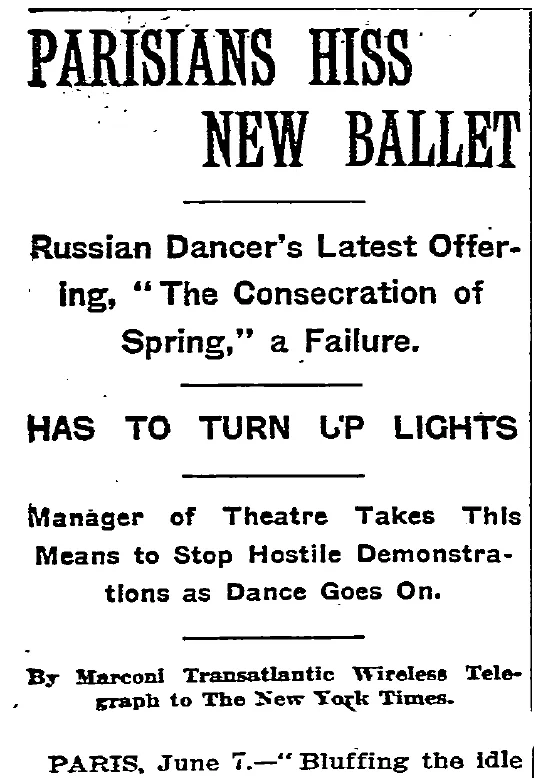
It's an oft-repeated bit of lore that Rite of Spring caused a riot when it first premiered in Paris on May 29, 1913. The truth of that depends on your definition of "riot;" a wire report of the concert in The New York Times read "Parisians Hiss New Ballet," deeming the work "a failure." But SFCM's Chair of the Music History and Literature Department, Rachel Vandagriff (right), says that we now know that those events were, in a way, engineered by the presenters and concerned more than just Stravinsky's daring music.

"It is very likely that not only did the orchestra play the score very badly, but also that no one could hear them because everyone was yelling," Vandagriff says. "But probably the thing that they were reacting to, almost certainly, was Vaslav Nijinsky's choreography. It was angular, downward facing— everything antithetical to that which French ballet idolizes, which is graceful, smooth lines and elevation."
But focusing on the night-of reaction doesn't give a complete picture of what led up to all that yelling, Vandagriff says. Stravinsky's collaborator on Rite, Sergei Diaghilev, left Russia for Paris to put on various productions as a form of cultural diplomacy and to help strengthen economic ties between France and Russia. Initially focusing on art exhibitions, he progressed to operas and ballets.
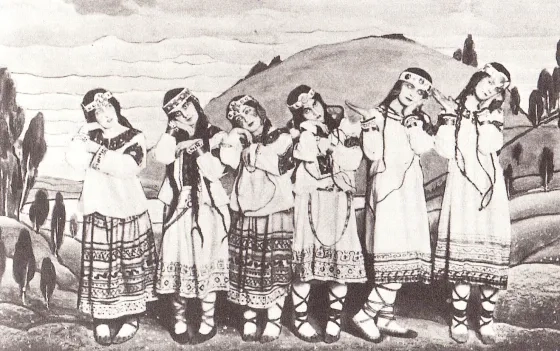
Dancers costumed in the original 'Rite of Spring' production.
French was the language of the Russian aristocracy from the 18th century forward, largely because it was the language of European politics, and so ballet, as it was practiced in Russia, was in the French style, Vandagriff says, which caused problems with Parisians hungry for "exotic" Russian culture. "The way Russians performed ballet was as the French would expect, but the French audiences, when Diaghilev was putting on ballet productions, were surprised because it didn't look Russian enough to them."
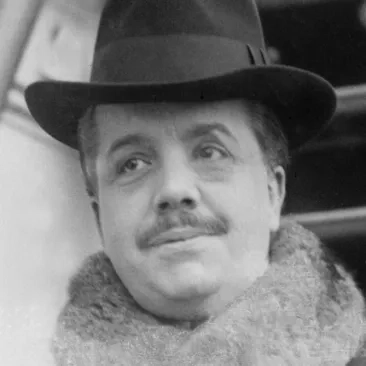
Sergei Diaghilev.
Diaghilev discovered Stravinsky through Nikolai Rimsky-Korsakov, having asked him for a composer who could write him a sufficiently Russian-sounding ballet. The first four students said no, but the fifth was Stravinsky, and that led to The Firebird, his first ballet for the Ballets Russes in Paris.
"Firebird's incredibly successful," Vandagriff continues. "It does exactly what Diaghilev needed it to do: serves up a taste of the exotic. So basically, you could think of the ballet productions from that point on as an export product, ballet designed for French audiences to perceive as Russian. In fact, the Firebird story is not a story in Russia. There's a firebird symbolism, and there's various Slavic folk tales in which a firebird appears, but the story of the Firebird ballet does not exist in Russian folklore. But the Parisian audiences ate it up."
Stravinsky and Diaghilev's collaboration next produced Petrushka, during which the composer got the idea for a ballet of a great sacrifice. For the visual side of things. A bit of an ethnographer and anthropologist, Roerich told Stravinsky about various pagan rituals from ancient Slavic cultures, which led to the composer collecting various anthologies of folk music, including a compendium of Lithuanian folk songs (via Rimsky-Korsakov), which is where Rite's opening bassoon melody comes from.
"What Stravinsky does with these folk songs in Rite of Spring," Vandagriff says, "is meld these to harmonies and with the octatonic scale, which he learned from Rimsky-Korsakov. He uses static ostinatos that create this hypnotic effect of the dislocation of meter, and the irregularity shifting stressed downbeats that override the metric regularity. Those were all new for European art music. Russian folk music had done all of those things. What was new for everybody was the combination."

"We had an interesting discussion in my class," Brown (left) says, "where we discussed through a modern sensibility, how it is for a composer to take folk melodies and, one could argue, make them ugly. Is he making fun of them? Does he have a right to do that? Is he appropriating material? Does it matter that Stravinsky was Russian? He certainly wasn't 'folk,' like a peasant, you know?"
Combined with Nijinsky's angular, flat-footed choreography that often featured dancers' upper and lower bodies moving against one another, Rite was catnip for a shrewd presenter like Diaghilev. "There were a variety of leaks to the press [about the work], Vandagriff says, "including an editorial Stravinsky supposedly wrote that ran the morning-of." Meanwhile, the theater owner, Gabriel Astruc, "made sure that they sent tickets to the upper-class bourgeoisie who expected ballet to look a certain way, as well as all the Bohemians who had interest in new ideas, and got them all in the theater that night." Consequently, the combined reaction to the choreography and the music led to an immediately hostile audience above which the music could barely be heard. Ballets Russes conductor Pierre Monteux would write later in the journal Dance Index that the audience united for at least one activity: "Everything available was tossed in our direction, but we continued to play on."
It's a testament to just how revolutionary Nijinsky's choreography was that once Rite was performed without the dancers, audiences were much less hostile. But Stravinsky would have to wait until April of 1914 for that moment, which happened shortly before the outbreak of World War I in August.
After the war, Brown says, "Stravinsky's style really shifted immediately. So there aren't many pieces like Rite of Spring. I feel, for a lot of people who are Stravinsky fans, their love ends with Rite, because afterwards he went in such a different direction. He never wrote anything like that again."
Learn more about the SFCM Orchestra or Music History & Literature at SFCM.