Student Businesses Shine at SFCM's Startup Incubator
Held as part of the Professional Development and Education Center's Arts Leadership Institute, SFCM's Startup Incubator hosts area investors as well.

From left: Irene Giovannetti, Luca Robadey, Ben Kitchen, and Zoe Lee.
There's no better place for a startup than San Francisco, and no better place for a musical one than SFCM.
The Conservatory's Professional Development and Engagement Center (PDEC) held its Arts Leadership Institute in May, which culminated in SFCM's Musical Startups Incubator pitch event, a daylong opportunity for students to show off their original business ideas to Bay Area investors.
Mentors and panelists attending this year included: Charles Huang, a co-founder of RedOctane and the co-creator of the enormously successful Guitar Hero video game franchise; Anna Dvornikova, Managing Partner at TEC Ventures, a Silicon Valley seed-stage fund and a Founder of SVOD, the Silicon Valley Open Doors International Startup Investment Conference; and Tianwang Liu, an economist and nonprofit leader. (Dvornikova was so taken with the students at this year's incubator that she added an additional $250 out of her own pocket to the money awarded to finalists.)
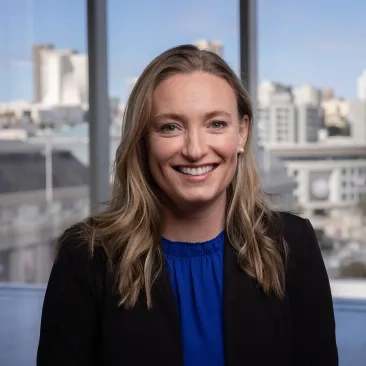
Other judges included Louisville Symphony Music Director (and SFCM alum) Teddy Abrams, who recently delivered SFCM's 2026 Commencement address; Mallory Loar, founder and CEO of Kindasorta Studio, a San Francisco agency that builds community programs for tech brands; Matthew Oberstein, Senior Vice President at SFCM's Alliance partner Opus 3 Artists, and of course, PDEC and Professional Development Dean Kristen Klehr (above left), who spearheaded both the incubator and the Arts Leadership Institute.
A trio of ambitious student projects stood out this year: '26 trumpet grad Irene Giovannetti's PracticePro app, '26 cello alum Zoe Lee's Resonant States sound bath series, and current students Ben Kitchen and Luca Robadey's Return Interval, a production company whose first project is an immersive multimedia experience called Dunes.
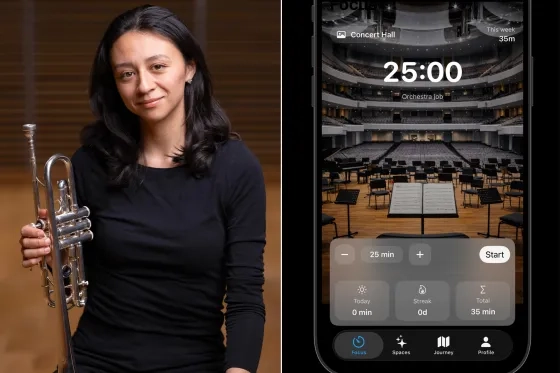
Irene Giovannetti and her practice app.
Giovannetti's app—currently live on the iPhone App Store—"gamifies" musicians practice sessions, she said. It allows students to budget a set amount of hours of practice tied to a particular goal (say, a seat in an orchestra), and provides motivational quotes, a variety of "virtual practice rooms," and a map of their dream performance venues as it counts down the hours a student logs in pursuit of their goal.
"With our instrument and all the work we do," Giovannetti explained, "it's funny that we can work a lot but then the moment we put the instrument away, it's like, 'Where's all that progress? Where did it go?' So the more you practice here, then you can see what you're building towards. It's been interesting because it makes me think a lot about how I manage my time, what I do, what keeps me motivated, what makes me practice more—or less."
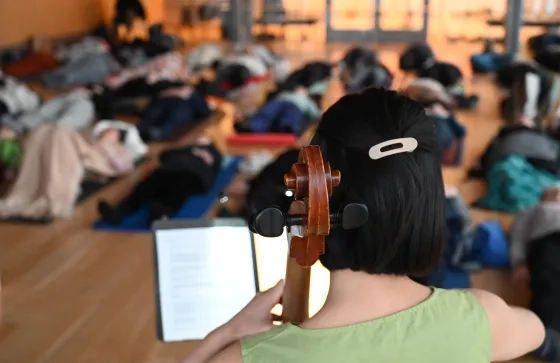
Cellist Zoe Lee performs at a Resonant States event.
Cellist Lee's Resonant States series of sound baths—an immersive experience that exposes participants to sounds from a variety of sources to aid in meditation, mindfulness, or general healing—debuted at SFCM in February. Like many SFCM students' business plans, the idea was nurtured in the Conservatory's Musical Startups class: "I had experienced a very memorable sound bath before and really loved it," Lee explained, "and since then had been dreaming about having a concert where people could lie down and listen."
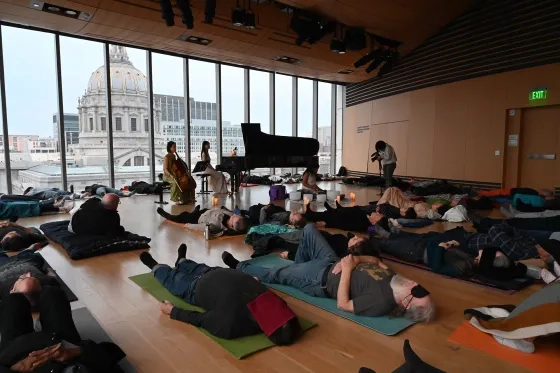
The sold-out performance in SFCM's Bowes Center.
Combining yoga, mindfulness meditation, and music, Lee was awarded a PDEC grant for her first event, and has since expanded the series to venues outside SFCM: The next Resonant States event will be held at San Francisco's venerable Community Music Center on June 19, and a documentary film about the series is also planned.
Dunes may have the largest proposed scale of any of the ideas pitched. Initially, Robadey wanted to use topographic data from sand dunes across the globe to generate actual music. But working with his professor, Mason Bates, convinced him to through-compose a single-arc work in five continuous movements that he says draws equally from classical compositions, his love of pop music (particularly Taylor Swift), and electronic dance music.
"The reason I chose to study with Mason was very much because I wanted to explore a side of composition that I didn't have a chance to really explore before," Robadey says. "Mason's big thing is 'themify the theme,' so he was constantly pushing me to develop things the audience could latch on to as anchors. In terms of really allowing myself to write, frankly, pop music, with melodies and hooks, Mason was really instrumental in pushing me."
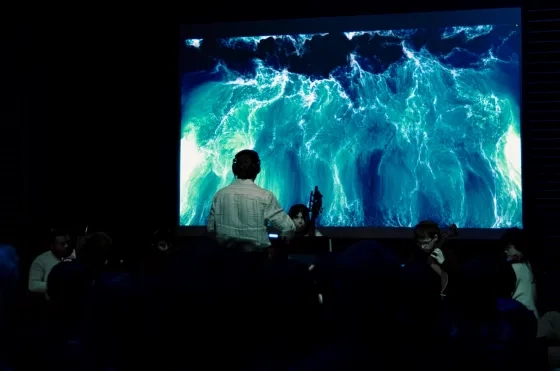
Luca Robadey conducts 'Dunes' in SFCM's Studio G.
With a deliberate emotional and musical arc mapped to deserts in Australia, China, Brazil, Algeria, and the U.S., Dunes won Robadey a PDEC grant to record the strings portion of the project at SFCM. Kitchen was on hand to engineer and also, crucially, mix Dunes in 9.1.6 spatial audio, taking full advantage of SFCM's Studio G's cutting-edge speaker array, as well as contributing the project's visuals, from animated projections to lighting.
The visuals for Dunes, though, are a key example of how students working in SFCM's Technology and Applied Composition (TAC) Department learn how to integrate visual elements into live performances. "Each movement had its own color," Robadey says: "We really wanted to tell the emotional story of the piece through the lighting and projections. For example, some of the projections would react to different elements of the music, like when a kick drum would hit, the animation of the sand would kind of shift." Using the visual coding language Max MSP, Kitchen was able to sync the lighting for the performance to the backing tracks using MIDI information as well.
"This first show was really about just seeing if this would work," Kitchen continues. "And it seemed like people were really interested in it, so the next step for us is figuring out how to bring it to venues outside of the school. A big thing that we learned from the startup incubator has been on the side of budget: We didn't really have very much background in how to run a production company on the budget side. So that was a huge thing."
Since the initial performance of Dunes was so tailored to Studio G, Kitchen and Robadey's long-term vision for how the project could "tour" to different venues (like, for example, San Francisco's Exploratorium), involves creating new mixes, musical scores, and animation packages for the project that customize it to a customer's needs. With this model in mind, a venue or ensemble could purchase all of the assets for the project directly from Return Interval, and, with minimal involvement from Robadey and Kitchen, stage their own version of Dunes anywhere.
"It's a lot of things to coordinate," Kitchen allows: "visuals, audio, lighting. But we're working really hard on figuring out a way to make it scalable so that anything from a string quartet to a symphony can play it or it can be 'put on' in say, The Sphere in Las Vegas. That's the ultimate goal."
Learn more about SFCM's Professional Development and Engagement Center and the Conservatory's Professional Development academic offerings.