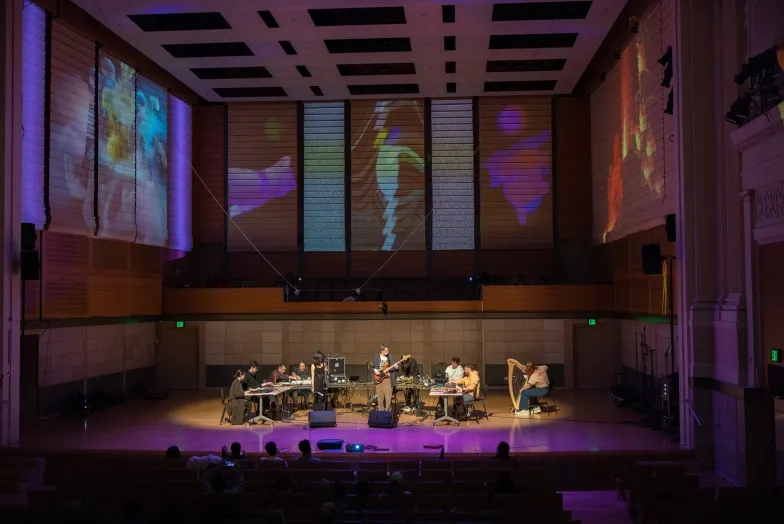
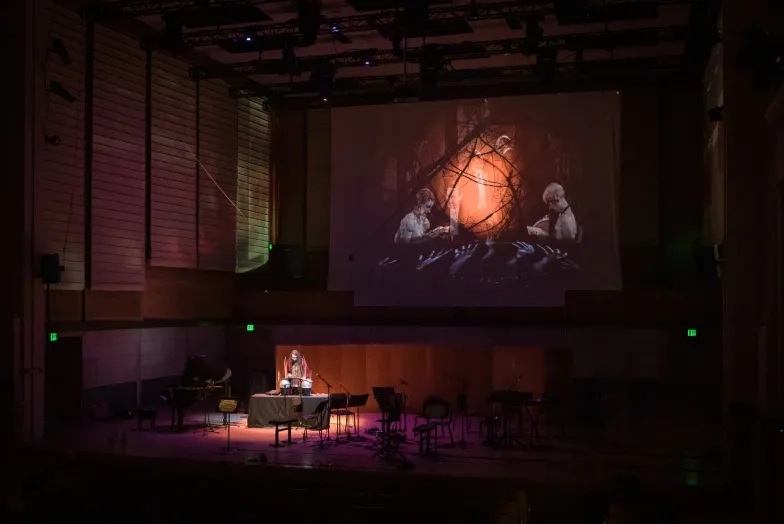
TAC Presents: ClimateMusic Project
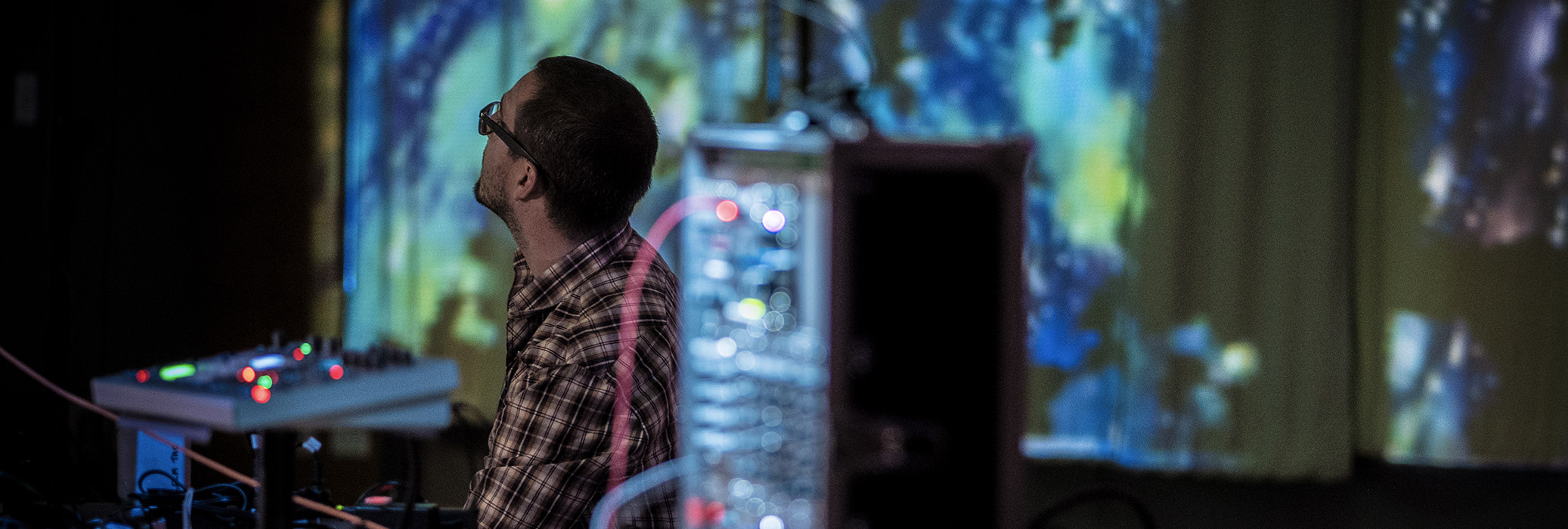
Program
Technology and Applied Composition Program in collaboration with ClimateMusic Project and Lawrence Berkeley National Laboratory
Changing Tides
Bleached Erica MacLeod
Bleached is a response to the climate crisis, specifically looking into rising sea levels and the bleaching of coral reefs around the world. Bleaching is caused by rising sea temperatures and changes in acidity (pH) of the ocean. These elements are represented artistically, with piano representing the reefs and sea life that lives amongst them, the swirling decay illustrating the rising sea level and demise of these habitats, and the ever growing synthesized elements that spread throughout the speakers represent the slow and steady increase of temperature and pH changes that are causing coral bleaching.
The decay, which interacts with the piano, has its feedback percentage automated to follow data regarding sea level rise, and its timing mapped to follow data regarding the human population affected by rising sea levels.
Data regarding pH/acidity changes determine the speed in which the synthesized elements spread throughout the speakers. ever growing until it dominates the sound world, as rising sea levels will affect the landscape of our oceans.
Dissolve Charles Stuedemann
When writing Dissolve for the climate music project, I chose to focus on how climate change is affecting the Great Lakes. Growing up on Lake Michigan, the protection and preservation of these lakes is something important to me. Climate change, specifically the rising temperatures, directly affects the Great Lakes by extending the evaporation season, after the winters when the ice melts. This leads to decreasing water levels. When analyzing the data over the past 100 years, the water level has dropped significantly. The Great Lakes have 13-year cycles of rise and fall. My goal was to translate this into music terms by showing the rise and fall of water levels, and the long term danger of decreasing levels. The structure of Dissolve is based on the rise and falls. Starting out low and mysterious, the track represents the frozen lake during the winter. When the tension slightly increases, this symbolizes the ice melting and the extended evaporation season beginning. The ending is a slight alteration of the beginning, representing the certain unknown of what next season can bring.
The Spark TJ Martin
The Spark is about the 2018 Camp Fire, the most deadly and destructive fire in California history. The fire was caused by several factors, including a very wet rainy season followed by a prolonged drought. This cause specifically is represented by the drops of water in the background, each of which represents a day with rain. This, along with high winds, created the perfect conditions for disaster, one that was finally triggered by a faulty PG&E transmission line. The fire covered an area of over 150,000 acres destroying more than 18,000 structures and killing 85 people. While this disaster was sparked by potentially illegal negligence on the part of BG&E, global warming contributes to the conditions that make fires like these more likely to start and spread.
Jahanam Jay Cruz, Parsa Mirzaagha
Jahanam is an acoustic representation of our world as it continues to be degenerated by our actions. The piece consists mainly of guitar and prepared piano, with each sound representative of Earth’s physical and acoustical characteristics. The intimate soundscape turns into cacophony, highlighting Earth’s eventual demise as a hospitable planet. Jahanam addresses the consequences of passivity and negligence, and recognizes the gluttony of those who will not live long enough to see the results of their actions.
Climate data of earth's energy balance is utilized to increase and decrease the frequency range of the instruments, alongside the CO2 concentration levels which control the reverb.
Visuals created by Trippy Everything
Degenerate Era David Gonzales
Degenerate Era is an octophonic, fixed-media piece that sonifies real and estimated worst-case scenario climate data extrapolated over the span of my estimated lifetime. Given that the gradual changes to Earth’s climate are often difficult to perceive, I wanted to explore what an average lifetime of gradual climate change might sound like were it condensed into a four-minute piece. The sonic material for this piece derives from a field recording* of waves splashing onto a rocky shore. The playback speed, direction, frequency, tempo and other sonic parameters of this field recording are manipulated by climate data points measuring CO2 concentration, emissions, near-surface air temperature, and the overall global balance of energy entering and leaving our atmosphere. Throughout the piece the original field recording is warped and stretched by the data until all that remains is an unrecognizable trace.
*Credit to Jeremy Rogers at The Sound Keeper for the original field recording.
Defensive Driving 009 Night
Defensive Driving is a quadraphonic piece about the human impact on climate change and sea level rise. One of the synthesizers’ sounds are shaped by a spectral graph that represents the world population data from 2021 - 2080. Car engine sounds represent the increase of CO2 emissions. Additional synths modulate throughout the piece utilizing automation data from sea level rise from 2021 - 2080. Extreme weather changes are represented by cymbals that use automation data to go from acoustic to distorted. The vocals in the piece represent warnings about climate change and get increasingly more synthetic throughout the piece until they are completely non-human sounding, and there are animal cries that represent the impact of climate change on other species. The spatial panning represents the atmosphere and the impact of climate change on our planet.
This piece is being performed with the addition of an application built with Max/MSP. The visuals, some vocal effects, and samples are being performed live.
Interim Jonathan Parra
Interim was composed with the intention of manifesting the potential dangers of the climate crisis if business is as usual. The composition is barebones, piano and synths inspired by sounds found in nature. It utilizes data from the past 170 years and 280 years of predicted data in the future (1850 - 2300). Specifically, the data that is being applied to the composition consists of the rise of Near Surface Air Temperature in Celsius and the increase of CO2 concentration. How this is being incorporated is each data entry has a purpose in the effects on the piece. Because of the rising numbers in each category, the effects of distortion, reverb, and delay on the piece become much more apparent as the piece progresses. Nearing the end of the piece, a disquiet feedback loop occurs because of the stronger effect of the delays, alluding to the effects of the suffocation of CO2 concentration in the atmosphere if little has changed from now to future generations.
summer all over Nicole Rowe
Using generated drums and chimes, "summer all over" is a sonification of surface area temperature and carbon dioxide emissions ranging from the year 1850 to their projected relative measurements in the year 2150. I based this piece entirely around our tendencies towards comfort- that is, our unwillingness to change our ways. The music feels comfortable at first, however as it continues, the music slowly becomes more and more uncomfortable as the bulk material does not change, but the effects (such as delay to represent carbon dioxide emissions, and distortion to represent heat) make the music feel increasingly jarring. At its core, "summer all over" represents the heating of the earth and its unfortunate consequences.
Submerged Frank Lin
Submerged is an ambient boom-bap piece that aims to portray the impending danger of climate change, and the effects that it has on the constantly rising sea levels observed on both coasts. According to CMP Apollo, projections show that by the year 2100, areas exposed to flooding in the United States will have increased by 75% from the year 2000. This exact projection is what shapes the soundscape and development of this track, utilizing the included data that shows the estimated rise in sea level from 2000 to 2100. The synthesized elements of ambient music are constantly evolving throughout the track using the data derived from the data provided by CMP Apollo, imported into CMP4Live. The linear, gradually rising data points gives the piece a through-composed feel that uses rising dynamics and frequency thresholds that indicate an increasingly dire situation.
Additionally, Submerged depicts the concept of “lag time,” which states that the effects of climate change are not an immediate result of our actions, but rather, a gradual process that takes years for the concurrent damage caused to our planet to become visible in the data. The track achieves this by maintaining a more ambient, calmer introduction that doesn't intensify until the first drum beat kicks in. Ultimately, Submerged should serve as a musical "call to action" of sorts for the listeners who understand the creative process of the piece.
Seachange Justin Yeo
This project is about the consequences of our negligence on climate change. It was done in Ableton using several waveforms from the software synthesiser Serum to create an evolving soundscape that simulates the real waves of the ocean, slowly getting higher and worse. A data set of sea level change from both MIT and BAU was imported into this project, and as the sea level data increases, it corresponds to the increasing value of MIDI voices and filter cutoffs. Granular synthesis is utilised, which I perform in real time, using Granulator on the sounds of ice breaking to represent ice caps melting. As this composition continues, more elements are added making it more hectic, including sounds of human voices, panicking, disasters, to sort of emphasise and reinforce the urgency of what humanity is doing to the earth.
beepbeepBeep Joshua Yee, Garrett Lucero
This piece represents the evolution and interaction of humans and the environment, and serves as a warning call for those who are less aware of the dangers of climate change. Following the intricacies of natural progression and the various shapes and forms that come with human’s impact on the planet, beepbeepBeep attempts to represent the future of our planet through both the damage that has already been done, while still remaining optimistic of the world to come. beepbeepBeep makes use of C02 emission and sea level rise data and predictions using filters and reverb to create the feeling of suffocation and drowning. The juxtaposition of acoustic and electronic elements highlights the weight of human actions both directly through the quintet, and indirectly through the creation of electronic elements from natural sound sources. beepbeepBeep invites you to look further than the damage that has been dealt, and into the future we could have.
When We Do Nothing Kristofer Twadell
Climate change is being sped up by the carbon dioxide that is being released by human factors. When We Do Nothing is a representation of the effects of this phenomenon and strives to give an auditory experience of data. Every sound in this piece is made of different graphs through the process of spectral analysis synthesis. This can clearly be heard by the rising pitches of the longer sounds that travel across the room. The notes in the short ascending and descending lines become further apart as time goes on, showing how the amount of carbon dioxide is expanding. The form of the piece also represents a graph, showing how the amount of CO2 in the atmosphere is exponentially increasing, ending with a fearsome cacophony that expresses what will happen if we do nothing to mitigate the carbon dioxide being released by human factors.
Birds Eye View Roman Baranskiy
When discussing the effects of global warming as it relates to rainforests most of us imagine deforestation, wildfires, and the elimination of pristine lands for croplands and pastures. Rarely do we imagine silent forests and oceans, or even think it significant. Yet both fish and birds are disappearing at an alarming rate, and with them their music.
Birds Eye View is based on data of global land use, and tells a story of diminishing forests, growing croplands, and sprawling urban developments. At the same time, it’s a story about changing sonic landscapes, where fragile music that once saturated the earth’s troposphere for millennia is now more faint than ever.
The writing of Birds Eye View was fairly straight forward. Each of the elements (forest, croplands, urban development, etc) was depicted with a musical element. For example, the forest was depicted by field recordings from the Amazon Rainforest; the pastures were illustrated by the sacred ceremony songs, distortion was used to depict CO2 emissions, and the human impact is demonstrated by the synthesizer, with growing clusters of chords.
The listener was meant to gradually find themselves in the midst of the chaos, not any different from where we are finding ourselves at this point in our planet’s history. We are to reflect on whether it is worth trading “music” for “noise”.
Credit to Loic Le Meur for “Sacred Village Ceremony” and George Vlad for “Amazon rainforest - Busy insect chorus at night” and “Amazon rainforest - Calm morning with birdsong” field recordings.
Eco vs. Ego Jenna Flohr
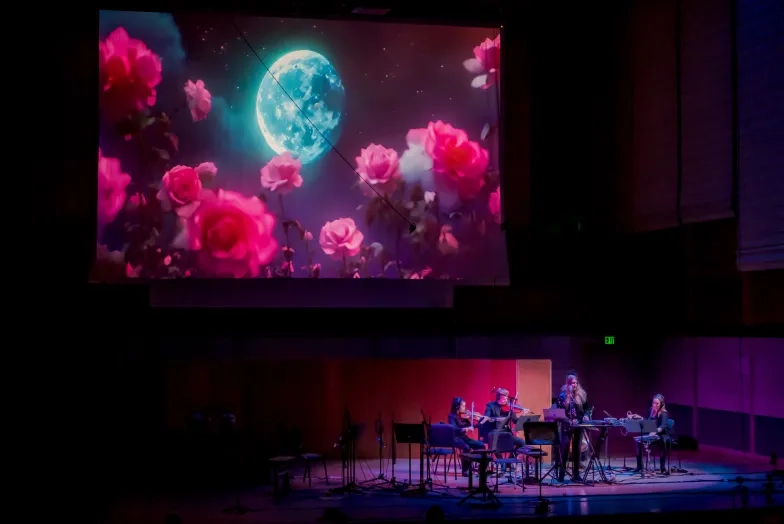
Violin - Solanch Sosa; Violin - Jenna Flohr; Viola - Paulina Flores; Viola - Katherine Brown
Eco vs. Ego is a three-phase exploration of the individual versus the overarching ecosystem. The impact from all of us individually can be seen on a grand scale when viewing the climate crisis. As sea levels rise, many ecosystems will continue to become displaced, as well as harmed due to these drastically changing conditions. In this work, we will explore together three different sections that represent the ecosystem before us, the ecosystem during our current condition, and the outcome of the planet reacting to ocean levels rising. The foundation of this work are water samples taken from river rapids in Atlanta, GA, as well as samples of the Pacific Ocean in San Francisco, CA. Through this coast-to-coast sound duality, we are connected by the same source. We have the resources to know how this outcome will end; it is ultimately up to us to decide where to go from here.
Credit to Source Sample - “Ego” by A Tribe Called Quest
ABOUT THE CLIMATEMUSIC PROJECT
WHAT DO YOU WANT THE FUTURE TO SOUND LIKE?
LISTEN. THEN ACT.
The ClimateMusic Project’s mission is to educate, inspire, and enable diverse audiences to engage actively on climate change through the creation and performance of science-guided music that viscerally conveys the urgency of taking action.
The ClimateMusic Project is looking for talented volunteers to join our team! We are especially looking for people with skills in the following areas: Communications, Design, Programming, Research, Data Analysis.
If your skills and talents are in other areas, reach out and we can have a conversation about where you might fit. This is an outstanding opportunity to join a collaborative of highly talented and committed individuals spanning the sciences, arts, and technology.
Drop us a line, and we’ll take it from there:
gurpyvzngrzhfvpcebwrpg@tznvy.pbzmoc.liamg@tcejorpcisumetamilceht
">
gurpyvzngrzhfvpcebwrpg@tznvy.pbzmoc.liamg@tcejorpcisumetamilceht
About SFCM’s Technology and Applied Composition Department
Get ready for a career on the edge of art and technology. Since its inception only a few years ago, the Technology and Applied Composition (TAC) program has taken off like no one could have imagined. This highly exclusive course of study gives students a direct path into the worlds of film scoring, video game sound design, and other rewarding musical avenues. Featuring instruction from some of the most visible composers in the industry today, the TAC music degree readies you for a cutting-edge compositional life, bridging art and technology in the most dynamic ways imaginable.
See more media from the TAC department.
Departments
 Technology and Applied Composition
Faculty
 Taurin Barrera
 MaryClare Brzytwa
 David Conte
 Kelley Coyne
 Marco d'Ambrosio
 Costas Dafnis
 Scott Foglesong
 Robert Gatley
 Julie Herndon
 Lenny Kiser
 Matt Levine
 Lennie Moore
 Mike Morasky
 Daria Novoliantceva
 Jason O’Connell
 Lucy Sheils
 Mary Ann Zahorsky
Upcoming Events